


What Are Programming Languages?
Programming languages are tools used to give instructions to a computer and perform desired tasks. Since computers cannot understand human language directly, we use programming languages to communicate with them.
A program or software is responsible for controlling hardware and completing tasks. The process of writing instructions for a computer is called programming, and the language used to write these instructions is known as a programming language.
Important Note : Programming languages act as a bridge between humans and computers. While low-level languages provide better control over hardware, high-level languages make programming easier and more efficient.
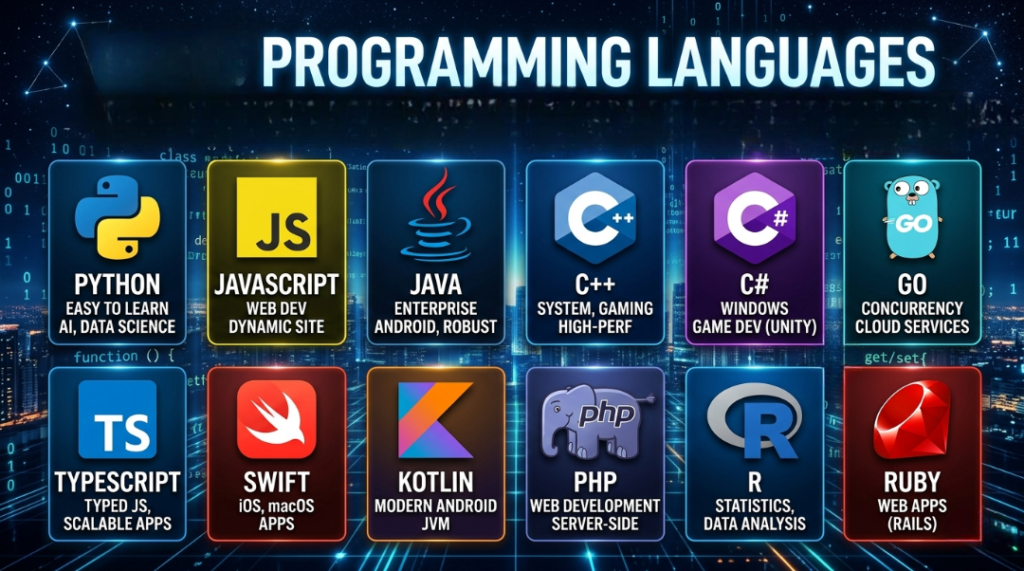
Types of Programming Languages –
Programming languages are mainly divided into two categories:
1. Low-Level Languages
2. High-Level Languages
- Low-Level Languages –
Low-level languages are closer to the hardware and are harder for humans to understand.
(a) Machine Language (1st Generation Language)
Machine language is the only language that a computer can understand directly.
It is written in binary code (0 and 1).
It is very fast but extremely difficult to write and debug.
Example: 10101010 11001100
(b) Assembly Language
Assembly language is slightly easier than machine language.
It uses mnemonic codes (like ADD, SUB, LDA) instead of binary.
It requires a translator called an assembler to convert it into machine language.
Easier to debug and saves time compared to machine language.
Example of Assembly Program:
START
LDA 5
ADD B
OUTPUT A
STOP
This program adds two numbers and displays the result.
👉 Assembly language is commonly used in microprocessors and embedded systems such as:
Air Conditioners
Microwave Ovens
Refrigerators
Washing Machines
Uses of Low-Level Languages –
Low-level languages are used where direct hardware control and high performance are required:
Operating Systems → Windows, Linux core parts
Device Drivers → Printer, keyboard, hardware control
Embedded Systems → AC, microwave, washing machine
Microprocessor Programming → Chips and controllers
Game Engines (Core Parts) → Performance-critical code
Robotics & Electronics → Direct machine control
- High-Level Languages
High-level languages are closer to human language and easier to learn and use.
(a) Third Generation Languages (3GL)
Examples: C, C++, Java, Python
Easy to write, understand, and maintain
Require a compiler or interpreter
(b) Fourth Generation Languages (4GL)
More advanced and user-friendly
Used for database queries and rapid development
Examples: SQL
Hence, High-level languages are used everywhere—from apps and websites to AI and automation. They make programming faster, easier, and more efficient compared to low-level languages.
Uses of High-Level Languages –
High-level languages are used in:
Software Development → Apps, software, games
Web Development → Websites & web apps
Mobile Apps → Android & iOS apps
AI & Data Science → Machine learning, data analysis
Database Management → Storing and managing data
Automation → Repetitive tasks automation
Most Popular Programming Languages (Latest Guide 2026)
There are many programming languages used today, but here are some of the most important and widely used ones explained in a simple way:
C Programming Language –
C is often called the “mother of all programming languages” because many modern languages are derived from it.
It is a structured, middle-level, general-purpose programming language.
Used for developing operating systems, system software, and applications.
Programs written in C are portable (can run on different systems).
History –
Developed by Dennis Ritchie in 1972 at Bell Laboratories (AT&T)
💡 Programming language C is Used –
Operating Systems (like Windows, Linux core parts)
Device Drivers
Embedded Systems
System-level programming
⭐Features
Fast and efficient
Only 32 keywords (easy to learn basics)
Strong foundation for beginners
💻 Example (Hello World in C)
#include <stdio.h>
int main()
{
printf(“Hello, World!”);
return 0;
}
C++ Programming Language –
C++ is an advanced version (extension) of C
It is a high-performance, object-oriented programming (OOP) language
Known for building games, browsers, and system software
History –
Developed by Bjarne Stroustrup in 1980 at Bell Labs
💡 Programming language C++ is Used
Game Development (core engines)
Operating Systems
Browsers
High-performance applications
⭐ OOP Features
Inheritance
Encapsulation
Polymorphism
Abstraction
Data Hiding
💻 Example (Hello World in C++)
#include <iostream>
using namespace std;
int main()
{
cout << “Hello World!”;
return 0;
}
Third Generation Languages (3GL) –
These are high-level languages that are easy to understand
Examples: C, C++, Java, Python
Used in general software and application development.
Java Programming Language
Java is one of the most popular and widely used high-level, object-oriented programming languages. It was designed by combining the best features of languages like C and C++, while removing their complexities.
Java follows the powerful concept of:
👉 “Write Once, Run Anywhere (WORA)”
This means Java code can run on any device that has a Java Virtual Machine (JVM) installed.
🔹 Features of Java –
Platform Independent – Run on Windows, Linux, macOS, and more
Object-Oriented – Based on OOP concepts like class, object, inheritance
Secure & Robust – Strong memory management and security features
Multithreaded – Can perform multiple tasks at the same time
Portable – Easy to move code across systems
History of Java –
Developed by James Gosling in 1991
Created at Sun Microsystems
Initially named “Oak”, later renamed to Java
💡 Programming language Java Is Used –
Java is used in a wide range of technologies:
- Web Applications
Websites and backend systems - Mobile Applications
Android app development - Desktop Software
GUI-based applications - Enterprise Applications
Banking, e-commerce, large-scale systems - Embedded Systems & Devices
Smart TVs
Air Conditioners
Microwave Ovens
IoT devices - Industrial Automation
Used in automated machines and industrial equipment
Python Programming Language (Latest Guide + Real-Life Uses) –
Python is a powerful high-level, general-purpose programming language known for its simplicity, readability, and versatility. It is one of the fastest-growing programming languages in the world and is widely used by beginners as well as professional developers.
Python’s easy syntax allows developers to write fewer lines of code, making development faster and more efficient.
🔹 Features of Python –
Easy to Learn & Use – Simple syntax similar to English
High-Level Language – No need to manage memory manually
Interpreted Language – Runs code line by line
Cross-Platform – Works on Windows, Linux, macOS
Large Libraries Support – Huge collection for AI, web, data, etc.
Scalable – Suitable for small scripts to large applications
💡 Python Is Used (Real-Life Applications)
- Web Development
Used to build scalable websites and web apps
Frameworks: Django, Flask
👉 Real-life:
Instagram backend
Pinterest - Artificial Intelligence & Machine Learning
Used in AI models, chatbots, and automation
👉 Real-life:
Recommendation systems in Spotify
Smart feeds in YouTube - Data Science & Analytics
Data analysis, visualization, and big data processing
👉 Real-life:
Business analytics and reporting tools - Automation & Scripting
Automates repetitive tasks like:
File handling
Data entry
Web scraping
👉 Real-life:
Auto email sending, report generation - Software Development
Desktop apps, tools, and utilities - Cybersecurity & Ethical Hacking
Used for penetration testing and security tools - Game Development (Basic)
Simple 2D games using libraries
🌍 Most Popular Companies Using Python –
Python is used by top companies worldwide:
YouTube
Instagram
Quora
Spotify
Mozilla
Fourth Generation Languages (4GL)
More advanced and domain-specific languages
Focus on database and rapid development
👉 Example: SQL
SQL (Structured Query Language) –
SQL (Structured Query Language) is a standard language used to manage and interact with relational databases. It allows users to store, retrieve, update, and manipulate data efficiently while maintaining data accuracy, security, and integrity.
🔹 Uses of SQL –
Data Management → Insert, update, and delete records
Data Retrieval → Fetch data using queries (SELECT)
Security Control → Manage user access and permissions
Data Integrity → Ensure accurate and consistent data
💡 Real-Life Applications –
Web Applications → User data, login systems (e.g., Instagram)
Banking Systems → Transactions and account management
E-commerce Platforms → Orders, products (e.g., Amazon)
Business Analytics → Reports and data analysis
Fifth Generation Languages (5GL)
Used in Artificial Intelligence (AI) and advanced computing
Focus on solving problems using logic and constraints
Command Languages –
Command languages are used to communicate with the operating system.
🔹 Examples:
(a) Shell
Used in Unix/Linux systems
Helps in running commands and scripts
(b) DCL (Digital Command Language)
Used in VMS operating systems
Generations of Computer Languages (1GL to 5GL) – Updated 2026
Computer languages have evolved over time to make programming easier, faster, and more efficient. This evolution is divided into different generations of programming languages, each representing a level of advancement.
🔹 Types of Computer Language Generations –
- First Generation Language (1GL) – Machine Language
The earliest form of programming language
Written in binary code (0 and 1)
Directly understood by the computer
Very fast but difficult to write and debug - Second Generation Language (2GL) – Assembly Language
Uses mnemonic codes (like ADD, SUB) instead of binary
Easier than machine language
Requires an assembler to convert into machine code - Third Generation Language (3GL) – High-Level Languages
Easy to read, write, and understand
Closer to human language
Examples: C, C++, Java, Python
Widely used for software and application development - Fourth Generation Language (4GL) – Domain-Specific Languages
Designed for specific tasks like database management and reporting
Requires less coding and increases productivity
Example: SQL - Fifth Generation Language (5GL) – AI-Based Languages
Used in Artificial Intelligence and machine learning
Focus on solving problems using logic and constraints
Used in advanced computing and automation
🎮 Programming Languages Used in Professional Game Development –
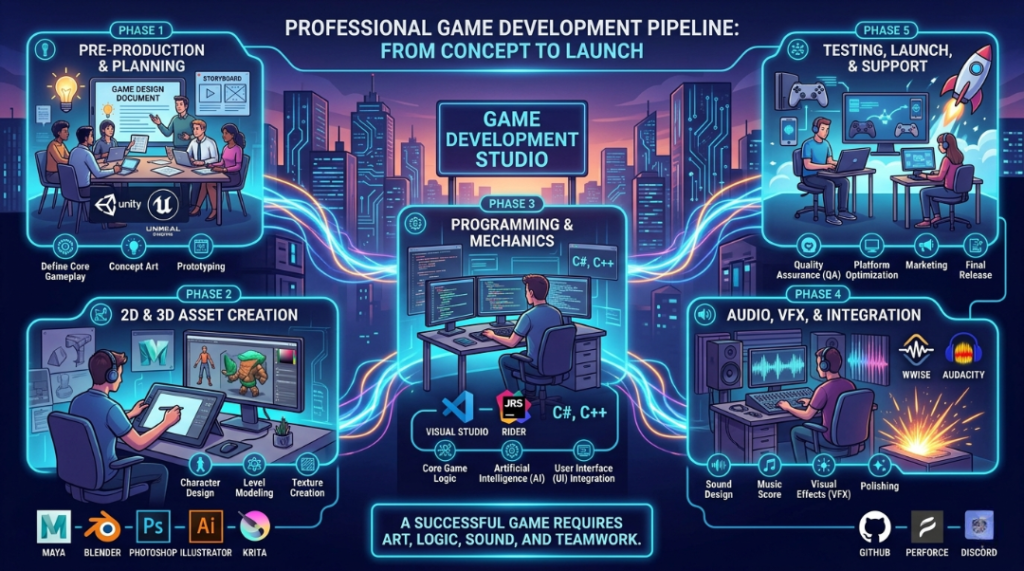
🔹 1. C++ (Core Game Engine)
High-performance games ke liye sabse important
Game engines (like Unreal Engine) ka core isi se bana hota hai
Graphics, physics, rendering handle karta hai
👉 Use: AAA games (GTA, Call of Duty type)
🔹 2. C# (Unity Engine)
Unity game engine me scripting ke liye use hoti hai
Easy aur beginner-friendly
👉 Use: Mobile games, indie games, PC games
🔹 3. Java / Kotlin (Android Games)
Android platform ke liye games banane me use hoti hain
👉 Use: Android mobile games
🔹 4. Swift / Objective-C (iOS Games)
Apple devices (iPhone, iPad) ke liye
👉 Use: iOS game development
🔹 5. Python (Tools & AI)
Game development ke tools, automation, aur AI logic me use hoti hai
👉 Use: Testing, scripting, backend tools
🔹 6. JavaScript (Web Games)
Browser-based games ke liye
👉 Use: Online games, HTML5 games
🔹 7. SQL (Database)
Player data, scores, login systems store karne ke liye
🔹 8. Shader Languages (Graphics)
Graphics aur lighting effects ke liye (GLSL, HLSL)
Note :
👉 Core Game → C++ / C#
👉 Mobile Games → Java, Kotlin, Swift
👉 Online Games → JavaScript
👉 Backend/Data → SQL
👉 AI & Tools → Python
Multiple Choice Objective Questions (MCQs)
Q1. Which of the following is a high-level programming language?
A) Machine Language
B) Assembly Language
C) Python
D) Binary Code
E) None of these
👉 Answer: C) Python
Q2. Which programming language is mainly used for database management?
A) C++
B) Java
C) SQL
D) Python
E) JavaScript
👉 Answer: C) SQL
Q3. Which language is commonly used for web development (frontend)?
A) C
B) Java
C) JavaScript
D) SQL
E) Python
👉 Answer: C) JavaScript
Q4. Which of the following is a low-level programming language?
A) Python
B) Java
C) Assembly Language
D) C#
E) HTML
👉 Answer: C) Assembly Language
Q5. Which programming language is widely used for Artificial Intelligence and Machine Learning?
A) C
B) Python
C) COBOL
D) Pascal
E) BASIC
👉 Answer: B) Python
Q6. What is the set of rules that tells a computer what operations to perform and how to perform them called?
A) Natural Language
B) Serial Language
C) Programming Language
D) All of the above
E) None of these
👉 Answer: C) Programming Language
Q7. Which language is applicable (understood) by all computers?
A) Machine Language
B) FORTRAN
C) BASIC
D) Pascal
E) None of these
👉 Answer: A) Machine Language
Q8. Which language is known as the “foundation language” for learning other programming languages like FORTRAN, Pascal, and ALGOL?
A) C
B) C++
C) American
D) COBOL
E) BASIC
👉 Answer: A) C
Q9. FORTRAN language is mainly used in which field?
A) Commerce
B) Science & Mathematics
C) Graphics
D) Business
E) Home Applications
👉 Answer: B) Science & Mathematics
Q10. Which programming language is widely used for internet-based applications?
A) C
B) C++
C) Java
D) Pascal
E) COBOL
👉 Answer: C) Java
Q11. A C program is converted into machine language with the help of which of the following?
A) Compiler
B) Editor
C) Framework
D) Assembly
E) All of the above
👉 Answer: A) Compiler
Q12. Which operating system is associated with Dennis Ritchie?
A) Android
B) Unix
C) Linux
D) Ubuntu
E) None of these
👉 Answer: B) Unix
Q13. What is the graphical or diagrammatic representation of an algorithm called?
A) Flowchart
B) E-R Diagram
C) 2-D Graph
D) Pie Chart
E) All of the above
👉 Answer: A) Flowchart
Q14. What type of programming language is C?
A) Object-Oriented
B) Advanced form of C++
C) Procedural
D) All of the above
E) None of these
👉 Answer: C) Procedural
Q15. What do we call a step-by-step set of instructions used to solve a problem?
A) Function
B) Flowchart
C) Debugging
D) Algorithm
E) Compiler
👉 Answer: D) Algorithm
Q16. Which keyword is used to define an interface in Java?
A) in
B) interface
C) intf
D) static void
E) getch()
👉 Answer: B) interface
Q17. What type of language is Java?
A) Strongly typed
B) Weakly typed
C) Moderately typed
D) Semi-typed
E) None of these
👉 Answer: A) Strongly typed
Q18. FORTRAN language is mainly used in which field?
A) Education
B) Image Processing
C) Business
D) Mathematics
E) None of these
👉 Answer: D) Mathematics
Q19. Which is the first high-level programming language developed for computers?
A) FORTRAN
B) LOGO
C) BASIC
D) COBOL
E) All of the above
👉 Answer: A) FORTRAN
Q20. Which of the following is known as a scientific programming language?
A) BASIC
B) COBOL
C) FORTRAN
D) PASCAL
E) None of these
👉 Answer: C) FORTRAN

Mujtaba Ansari is a Software Engineer, Founder & CEO of The Tech Earth. He writes about technology, AI, software, cybersecurity, blogging, Health tech, Agri Tech and digital trends to help readers stay updated with the latest innovations.