

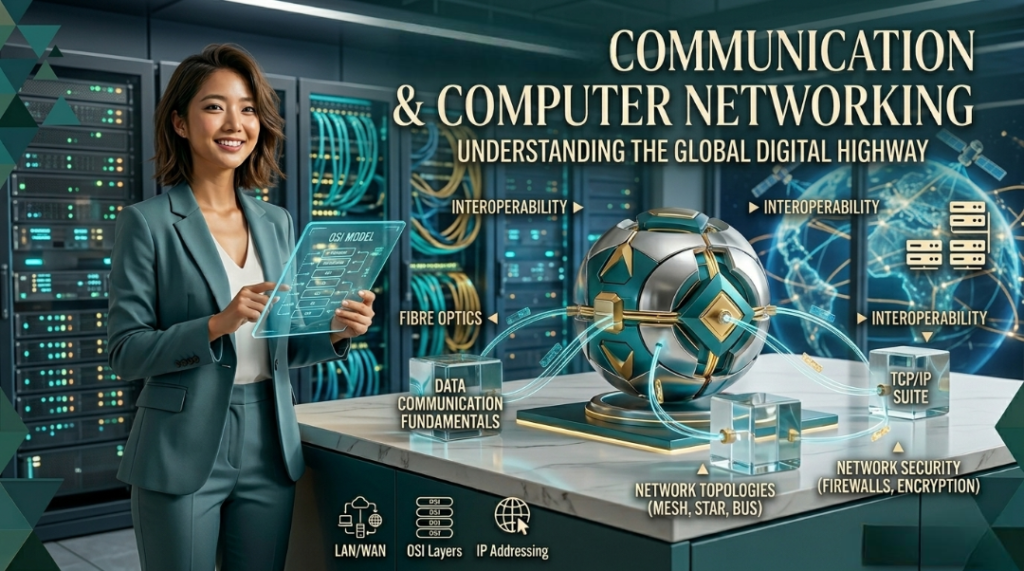
What is Data Communication?
Data communication is a process in which data is exchanged between two devices through a communication medium. This is called Data Communication.
This communication medium can be either wired (Ethernet cable, fiber optic cable, telephone line etc) or wireless (Wi-Fi, mobile network, mobile network, Satellite communication etc).
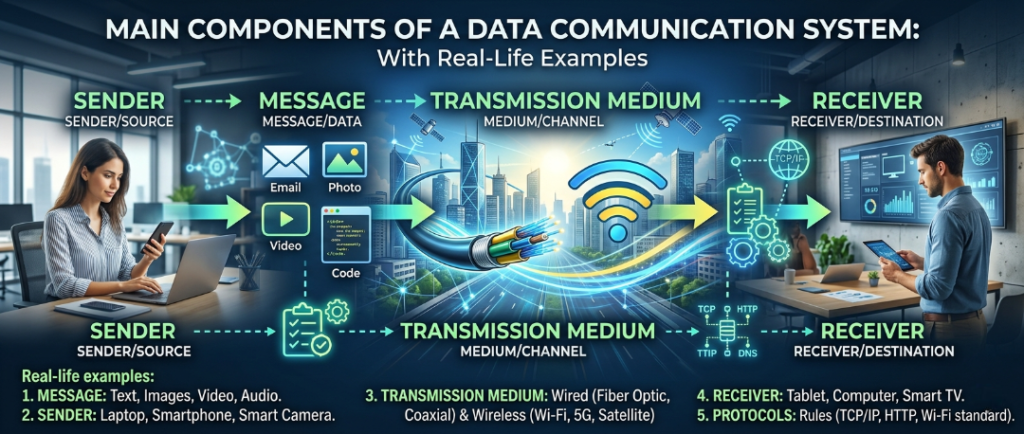
Main Components of Data Communication system with real life examples –
In real life, the communication systems we use consist of 5 main parts. Only then can proper communication take place between two devices. These five components play an important role in ensuring effective communication, which are as follows:
1. Message
2. Sender
3. Receiver
4. Transmission Medium
5. Protocol
- Message:
A message is something you use to share your thoughts or information with another person.
It can be in the form of text, picture, video, audio, or number.
2. Sender :
It is a device used to send messages or share your thoughts with others.
Examples: Mobile, Computer, Telephone, etc.
3. Receiver :
It is a device used to receive message or information, is called receiver.
Example: Mobile, Computer, Telephone, T.V etc.
4. Transmission Medium :
It is a path through which a message or any information travels from the sender to the receiver.
It can work through wires or without wires.
Examples: Wireless technology, optical fiber cable, twisted pair cable, coaxial cable, etc.
5. Protocol :
To make everything work properly, there are rules. In the same way, a protocol is a set of rules that devices follow to communicate correctly with each other.
Without protocols, two devices can connect, but they cannot communicate clearly or properly.
Some Important main network protocols:
HTTP (Hypertext Transfer Protocol)
TCP/IP (Transmission Control Protocol – Internet Protocol)
SMTP (Simple Mail Transfer Protocol)
FTP (File Transfer Protocol)
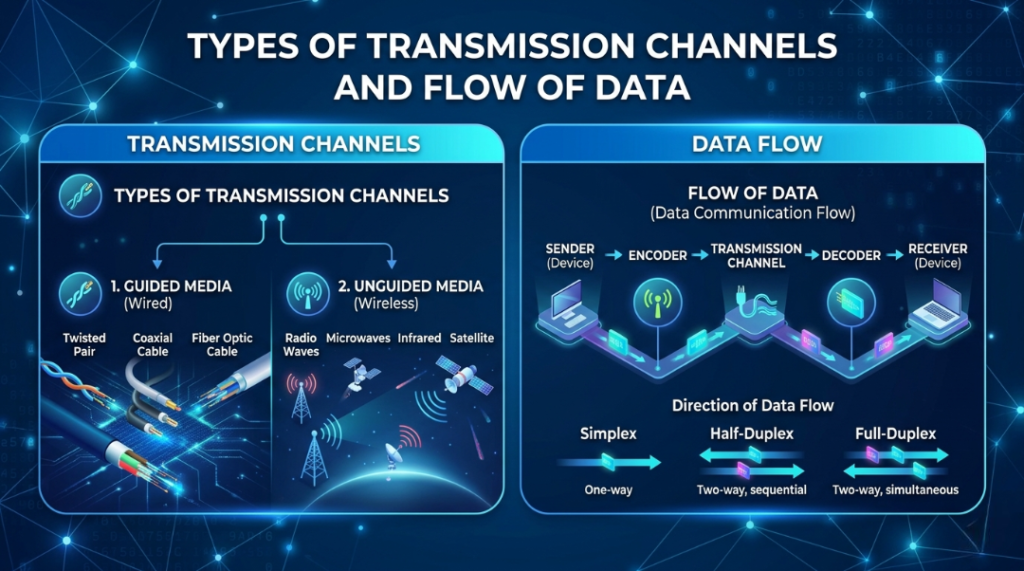
Types of transmission Channels and Flow of Data: Types, Examples & Uses –
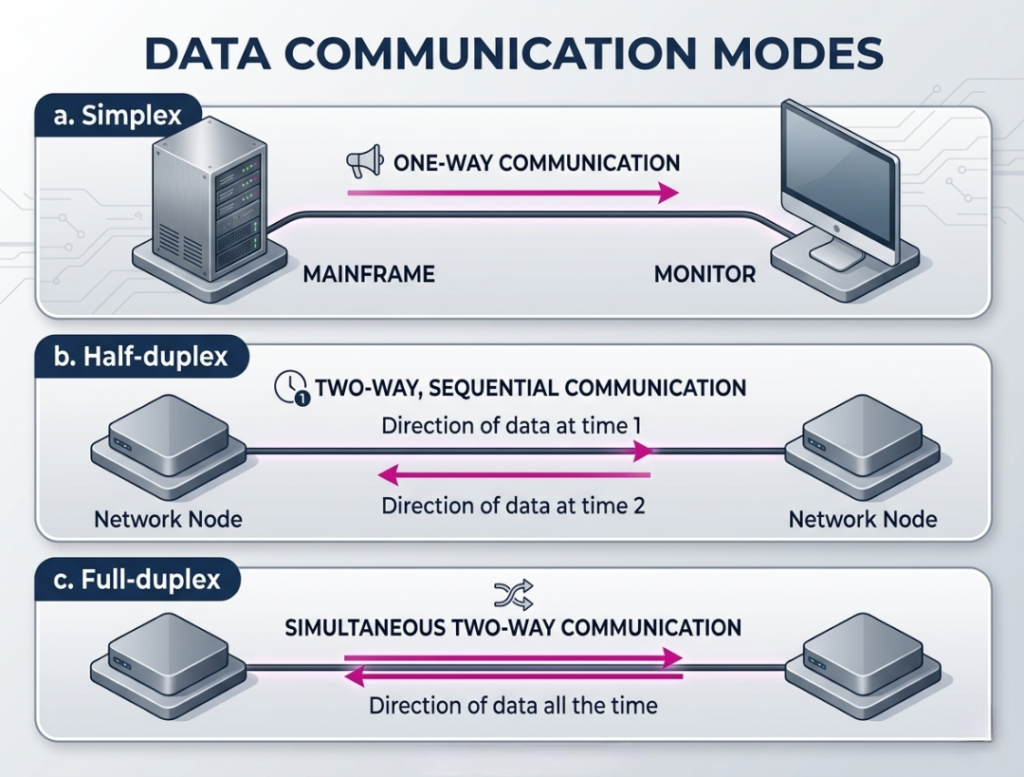
The flow of data between any two devices mainly in three ways. These are also known as the modes of communication.
(1) Simplex:
In simplex mode, data flows only in one direction. One device can only send data, while the other device can only receive it.
Example: Keyboard to computer.
(2) Half Duplex:
In this , data can flow in both directions, but only one direction at a time.
Example: Walkie-talkie.
(3) Full Duplex:
In this mode, data can flow in both directions at the same time. Both devices can send and receive data simultaneously.
Example: Telephone or mobile.
What are the main benefits of Data Communication:
Some main benefits are as follows:
1. ) Time Saving – Data is sent and received instantly very fast.
2.) Accuracy – Data remains correct with fewer errors or data is reliable and mostly error-free.
3.) Low Cost – Information can be shared at a very low cost.
4.) Good Communication – Any people can talk and share the information very easily.
5.) Fast Access – Any data is easy to find and open in less time.
6.) Supports Modern or AI Technology – Helps run internet, apps, and digital systems smoothly and very fast. Helps new technology work easily and properly.
7.) Data Safety & Storage – All data is saved safely and can be used later any time.
8.) Easily Remote Access – You can use your any data from anywhere using the internet.
9.) Better Performance – Work is done faster and more Correctly.
10.) No Duplication & Accuracy – Prevents file duplication and keeps data accurate.
Objective Questions
(1) Data communication is called — ?
(a) Exchange of devices
(b) Exchange of data
(c) Group of disks
(d) All of the above
(e) None of these
(2) What is a computer that connects two networks called?
(a) Gateway
(b) Server
(c) Link
(d) Bridge
(e) None of these
(3) Which is considered the first computer network in the world?
(a) ARPANET
(b) I NET
(c) V NET
(d) Internet
(e) None of these
(4) Personal computers can be connected to each other in —
(a) Mainframe computer
(b) Server
(c) Node
(d) Network
(e) Supercomputer
(5) ———- is a set of rules.
(a) Domain
(b) URL
(c) Hypertext
(d) Protocol
(e) Resource Locator
(6) On which principle does Fiber Optic work?
(a) Total Internal Reflection
(b) Interference
(c) Reflection
(d) Scattering
(e) All of the above
(7) What is the full form of SIM?
(a) Self Identity Machine
(b) Subscriber Identity Module
(c) Self Identity Module
(d) Subscriber Identity Machine
(e) None of these
(8) Bank ATM system is an example of which network?
(a) LAN
(b) MAN
(c) WAN
(d) Mixed Networking
(e) CAN
(9) Which of the following is a small single-site network?
(a) WAN
(b) MAN
(c) DSL
(d) CPU
(e) LAN
(10) To allow an external organization to access internal web pages, what is used?
(a) Internet
(b) Hacker
(c) Extranet
(d) Hardware
(e) Intranet
(11) In television broadcasting, picture signals are transmitted by —
(a) Angle modulation
(b) Amplitude modulation
(c) Frequency modulation
(d) Phase modulation
(e) None of these
(12) Wi-Max is related to which of the following?
(a) Missile technology
(b) Space technology
(c) Biotechnology
(d) Communication technology
(e) All of the above
(13) A communication network used by large organizations at regional, national, and global levels is called —
(a) VAN
(b) WAN
(c) LAN
(d) MAN
(e) None of these
(14) What is the full form of WLL?
(a) Wireless in Local Loop
(b) Working Land Line
(c) Working Loop Line
(d) Wireless Land Line
(e) All of the above
(15) Bluetooth technology enables —
(a) Signal transmission on mobile phones
(b) Wireless communication between devices
(c) Landline to mobile communication
(d) Satellite telephone communication
(e) None of these
(16) What is the commonly used unit to measure data transmission speed?
(a) Nanosecond
(b) Megahertz
(c) Bits per second
(d) Nanohertz
(e) Millibyte
(17) A private network used by employees of a company within the same location is called —
(a) ARPANET
(b) LAN
(c) WAN
(d) Internet
(e) Intranet
(18) Under the National e-Governance Plan, what is SWAN?
(a) System Wise Area Network
(b) State Wise Area Network
(c) State Wide Area Network
(d) System Wide Area Network
(e) None of these
(19) What is used to increase network length without reducing signal strength?
(a) Switch
(b) Repeater
(c) Router
(d) Gateway
(e) None of these
(20) What is NICNET?
(a) Another name for the Internet
(b) An international network
(c) A network made of special wires
(d) A network connecting all districts of India
(e) All of the above
ANSWERS
 (1)-b   (2)-a   (3)-a   (4)-d
 (5)-d   (6)-a    (7)-b (8)-c
 (9)-e   (10)-e  (11)-b (12)-d
 (13)-b (14)-a  (15)-b  (16)-c
 (17)-b  (18)-c  (19)-b (20)-d

Mujtaba Ansari is a Software Engineer, Founder & CEO of The Tech Earth. He writes about technology, AI, software, cybersecurity, blogging, Health tech, Agri Tech and digital trends to help readers stay updated with the latest innovations.