

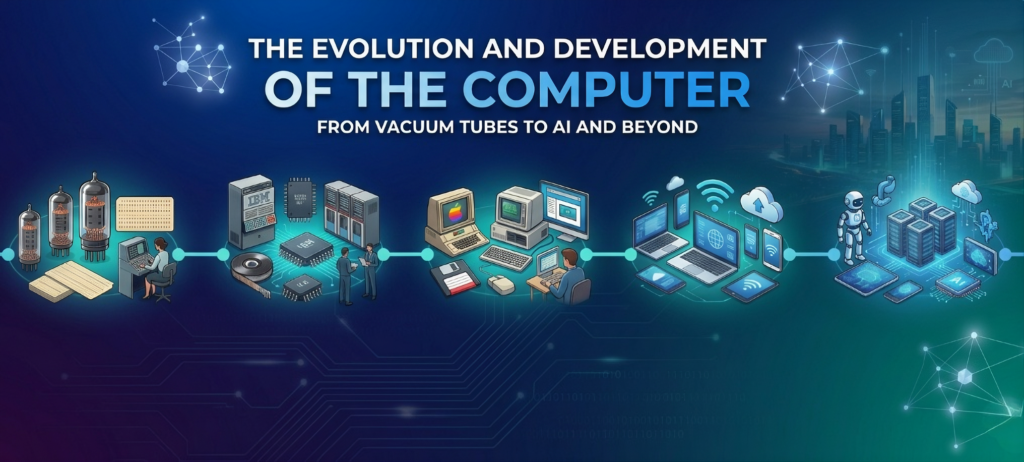
History of Computer –
In the 19th century, British mathematics professor Charles Babbage introduced the term computer. It evolved from a wooden abacus to the latest high-speed microprocessor. Charles Babbage designed the Analytical Engine, the basis on which today’s computers operate. Computer technology continues to evolve from time to time. Therefore, the following is a list of who created and introduced which type of computer to the world from the beginning:
After the 19th century, electronics began to be used in computers in the 20th century, with the use of vacuum tubes, transistors, and then microprocessors. Today’s computers have become fast, small, and powerful, used for the internet, AI, and multimedia.
Computer development means advancing computers from simple calculation machines to today’s modern, high-speed, Artificial Intelligence (AI), multipurpose devices.
(1) Abacus :-
It is considered the world’s first calculating device. It was invented in China in the 16th century. It was used for arithmetic calculations. It made calculations easier with the help of circular beads strung on wires.

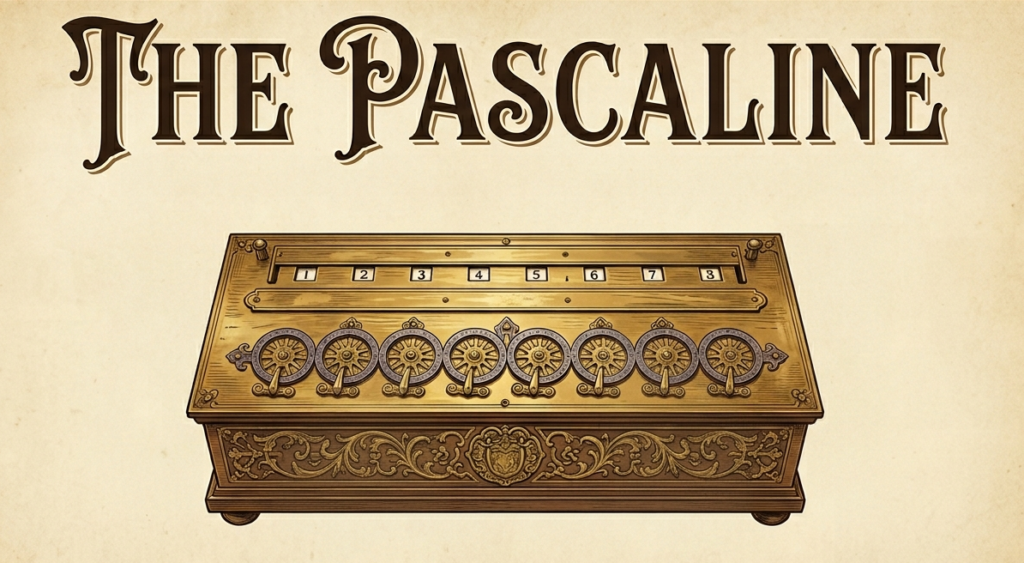
(2 ) Pascaline :-
The Pascaline, also known as Pascal’s calculator, was invented in 1642 by the French mathematician Blaise Pascal, who invented the first mechanical calculating machine. It consisted of a parallelogram box with eight movable wheels. It could only add or subtract. Therefore, it was also called an adding machine.
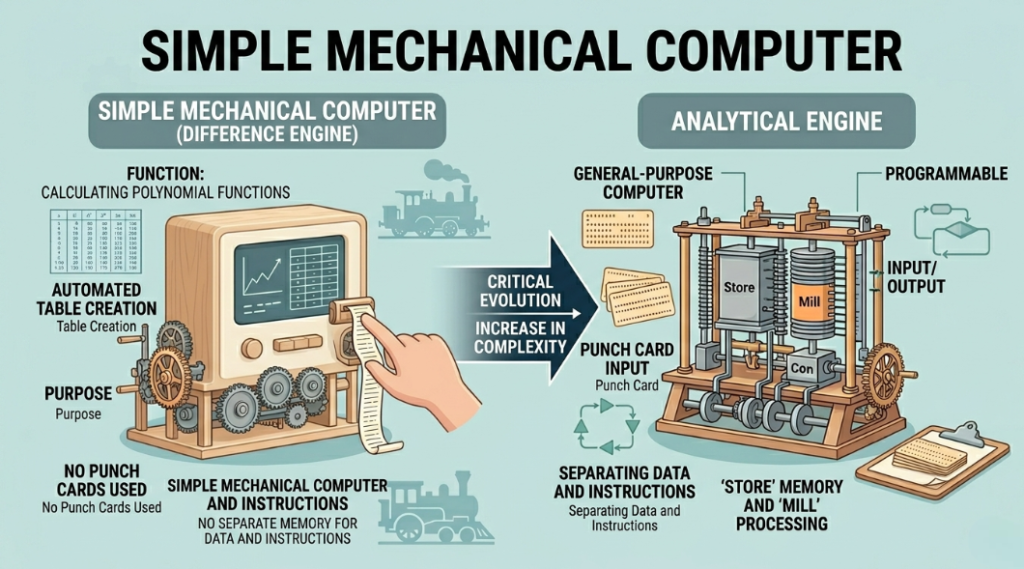
(3) Difference Engine or Mechanical Computer and Analytical Engine :-
Charles Babbage, known as the father of the computer, invented the Difference Engine in 1822, which was powered by steam and could perform calculations. This Difference Engine is also known as a mechanical computer.
In 1833, Charles Babbage created an automatic machine, the Analytical Engine, which could perform arithmetic calculations such as addition, subtraction, multiplication, and division according to punch card instructions.
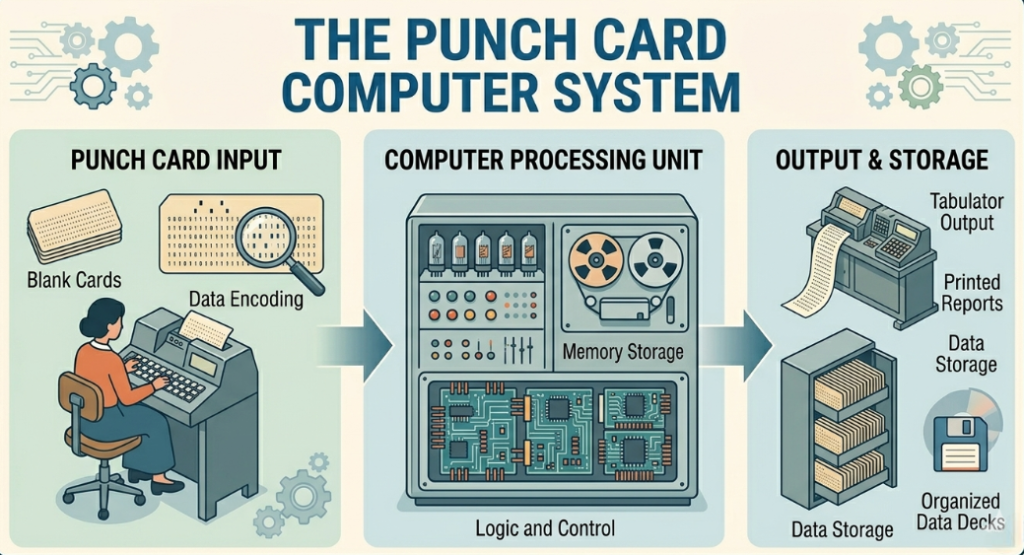
(4) Punch Card :-
Punch card was invented by American scientist Herman Hollerith in 1880, which was like today’s computer card.
(5) Vaccum Tube :-
A vacuum tube is an electronic device that controls current and amplifies signals. Early computers, such as First Generation Computers (1940s-1950s), used vacuum tubes to process data and perform calculations.
The vacuum tube was like an electric switch that helped the computer to think, understand, and perform calculations.
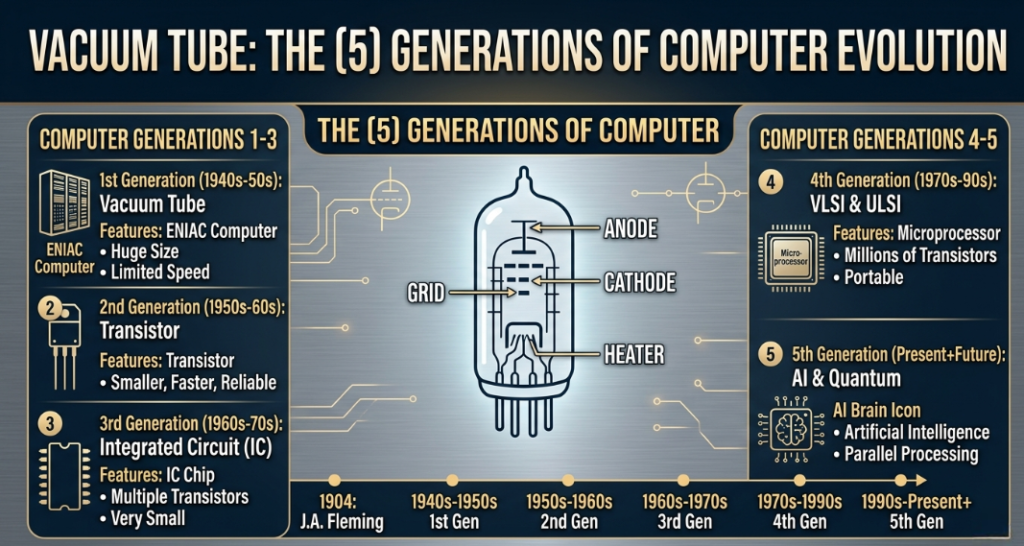
(6) ENIAC – Electronic Numerical Integrator and Computer / Calculator :-
The invention of the first electronic computer for general purposes was made in 1946 by American scientists John Mauchly and J. P. Eckert, and it was named ENIAC. It was used for weather forecasting and scientific purposes.
(7) UNIVAC 1 – Univarsal Automatic Computer :-
It was developed by GEC (General Electric Corporation) in 1954. It was the first computer used for business, personal work, and other general tasks.
(8) Transister :-
Transistors are small electronic devices that control or amplify electrical signals in a circuit.
It was used in 2nd generation computers which work faster than 1st generation computers. Ex.: IBM 1401, UNIVAC – 1107
(9) I.C. (Integrated Circuit) :-
It is a small electronic chip in which many electronic components like transistors, resistors, capacitors are connected on a single chip.
IC was used in the 3rd Generation, its latest form was introduced by Intel which was called Micro-processor.
(10) Micro-Processor :-
This is a small electronic chip that is the brain of the computer.
The microprocessor processes instructions and controls some or all of the computer’s functions.
Developed by Intel in 1970, it revolutionized the computer industry. The first microprocessor, the Intel 4004, was developed in 1970. Its development made possible the creation of smaller computers, known as microcomputers.
Computer Generation :-
Computers have been developing from the beginning till today. During this time, computers have moved from “Vacuum Tubes” to “Artificial Intelligence” and have changed from occupying a large room to fitting in our hands. This progress has been achieved over the last 70–80 years.
This period of development is called Computer Generation. As changes happened in computer hardware and software, different computer generations were defined accordingly.
So far, 5 generations of computers have been identified. Research is still going on for the next generations.
Computer generation is the development time period of computers, in which computers are divided into different generations based on changes in technology, hardware and software.
As new research or inventions took place (like from vacuum tube to transistor, then I.C., microprocessor and now Artificial Intelligence), the generations of computers got updated accordingly.
Currently, the 5th Generation of Computers is underway.
This generation of computers is based on Artificial Intelligence (AI), in which computers have become increasingly intelligent and are developing the ability to think, understand, learn, and make decisions on their own. This means that all systems are now becoming automated.
(1.) First Generation :
The computers developed from 1940 to 1956 are known as the First Generation. The development of first-generation computers began with vacuum tube technology.
Memory Used –
Punch cards, paper tape
Speed -
Milliseconds (ms)
Examples of some first-generation computers include:
Mark-1, IBM-650, IBM-701, UNIVAC, EDSAC, ENIAC, EDVAC, etc.
Uses –
Scientific and defense applications
(2.) Second Generation :
The computers developed between 1956 and 1963 are known as the Second Generation. Second-generation computers were developed using transistor technology instead of vacuum tubes.
Memory Used –
Magnetic Disk, Magnetic Tape, Magnetic Memory.
Speed -
Microseconds (ms)
Some examples of computers of this generation include the IBM 1620, IBM 7094, Honeywell 400, UNIVAC-1108, CDC 1604, and CDC 3600.
Uses –
Commercial and scientific use.
(3.) Third Generation :
The computers developed between 1964 and 1971 are known as the Third Generation. This generation saw the introduction of ICs. IC stands for Integrated Circuit. ICs were developed by Jack Kilby in 1958.
Memory Used –
Increase in Storage Capacity in Magnetic Memory
Speed -
Nano second (ns)
Examples of computers of this generation are:
IBM-360 Series, Honeywell-600 Series, PDP (Personal Data Processor)
Uses –
Personal use of computers.
(4.) Fourth Generation :
This generation dates back to 1971-1980. This generation introduced modern IC technology. This IC technology was known as VLSI (Very Large Scale Integration). High-level programming languages were used for programming.
Memory Used –
Semiconductor Memory
Speed -
Pico-second (ps)
Some examples of fourth-generation computers are:
Star 1000, Dec 10, PDP 11, CRAY-1, CRAY-X-MP (Super Computer), PCs.
Uses –
Increase in personal use, commercial production.
(5.) Fifth Generation :
This generation of computers is considered to have begun in the 1980s. This generation introduced modern IC technology, known as ULSI (Ultra Large Scale Integration). Programming in high-level languages was simpler. These languages used GUIs (Graphical User Interfaces).
Memory Used –
Optical Disk, Virtual Memory
Speed -
Extremely fast.
Some examples of fifth-generation computers are:
Desktop, Laptop, Notebook, Ultrabook, Chromebook, etc.
Uses –
Internet and multimedia use.
Next Generation Of Computer :
Next-generation computers are those that come after the 5th generation and have already begun.
They will be more intelligent, fast, and efficient.
They will use advanced artificial intelligence, quantum computing, and nanotechnology.
These computers will be capable of human-level thinking and problem-solving. This has already begun, and
Research is ongoing to determine how they will become more powerful in the future.
(1) Nanocomputer:
Attempts are being made to develop a computer with extremely small and large capacity using nanotubes fabricated at the nanoscale (10^-9m).
(2) Quantum Computer:
- This computer is based on the quantum theory of light, where data is stored and processed using quantum particles. These particles exist in pairs and are called “q-bits.”
Types Of Computer :
Based on working method, there are 3 types of computers.
- Analog Computer
- Digital Computer
- Hybrid Computer
- Analog Computer :
- In this, a physical quantity changes continuously with time.
For example: pressure, voltage, temperature, etc.
Analog computers have slow speeds. Some examples of analog computers include:
A simple clock, its speedometer, voltmeter, barometer, etc.
OR
An analog computer is a computer that works with continuous data, such as speed, temperature, or pressure, instead of just numbers.
An analog computer measures physical quantities and displays the result.
Examples: Speedometers, old flight simulators.
Hence, It works with real-world continuous values, not numbers.
2. Digital Computer :
- These computers run on electronic signals and use the binary system (0, 1) for calculations. They are very fast.
Currently, all computers are of this type.
Some examples include:
Personal Computers (PCs), digital watches, PDAs (Personal Digital Assistants), etc.
OR
It is a computer that works with discrete data (numbers and symbols), not continuous values.
It processes data in binary form (0 and 1).
Example: all smartphones, laptops, desktops, etc.
Since, digital computers work with numbers and symbols, not real-world continuous values.
3. Hybrid Computer :
- It is a hybrid of analog and digital computers. Input and output are analog, but processing is digital.
This type of computer is mostly used in hospitals, science, defense, etc.
OR
It is a combination of an analog and a digital computer.
It processes both continuous data (like analog) and discrete data (like digital).
Example: Modern medical equipment such as ECG (Electrocardiogram / Electrocardiography ) machines.
Hence: It handles both types of data – both continuous and numerical. This is called a hybrid computer.
There are 4 types of computers based on size and function:-
(1) Micro Computer
(2) Mini Computer
(3) Main Frame Computer
(4) Super Computer
(1) Micro Computer :
Microcomputers use a microprocessor as their processor. Its development began in 1970 by IBM. Microcomputers are also called personal computers.
For example, PCs, laptops, tablets, notebook computers, and smartphones are all different forms of microcomputers.
OR
This computer is a small computer designed for personal use.
It runs on a microprocessor.
Example: Desktop, Laptop, Tablet, Mobile
(2) Mini Computer :
- This computer is larger than a microcomputer and smaller than a mainframe computer. It has greater storage capacity and speed. It was invented in 1965 by a company called DEC (Digital Equipment Corporation). It uses more than one microprocessor. About 250 users can easily work simultaneously.
It is used in passenger reservations, education, hospitals, companies, airports, research, government organizations, etc.
OR
This computer is a medium-sized computer that can serve multiple users simultaneously.
It is larger than a microcomputer and smaller than a mainframe.
Example: PDP-11, VAX series.
(3) Main Frame Computer :
- Mainframe computers are large in size and have a large storage capacity. They have a fast data processing speed. Approximately 100,000 to 100,000 users can work simultaneously.
They are used in banking, railways, aerospace, defense, large companies, etc.
(4) Super Computer :
- A supercomputer is a computer whose storage capacity and speed
exceeds all other computers. It contains thousands of microprocessors. It is the most powerful
computer ever built.
The world’s first supercomputer was the Cray-1, developed by the American Cray Research Company in 1976.
Seymour Cray is considered the father of the supercomputer.
Many users can work on it simultaneously.
It is used in weather forecasting, scientific technology, space research,
petroleum research, medicine research, etc.
- First Supercomputer in India:-
The first supercomputer in India was PARAM, which was built by C-DAC in 1988.
Fastest Super Computer of the World:-
The two fastest computers in the world are from America. The names of these two computers are Summit and Sierra.
Both of them use IBM technology.
Summit was crowned the world’s fastest computer in June 2018. It performed the mathematical test
LINPACK at 122.3 petaflops per second.
Before Summit, China’s Sunway Taihulight was the world’s fastest computer, with an estimated cost of $273 million.
Overall, of the world’s 10 fastest supercomputers, five are from the United States,
one from China, and one each from Switzerland, Japan, and Germany.
India’s Fastest Computer:
India’s fastest supercomputer, as of January 2018, is Pratyush (Cray Xc40). It has a memory capacity of 1.5 Tb (terabyte). It was inaugurated on January 8, 2018, by Dr. Harsh Vardhan, Union Minister of Earth Sciences.
It is located at the Indian Institute of Tropical Meteorology (IITM) in Pune. India’s top supercomputer
Speed is 42.56 T FLOPS per second.
Top 5 Supercomputers in India:
The names of India’s 5 fastest supercomputers are:
- Pratyush – Cray Xc40
- Mihir – Cray Xc40
- In C1 – Lenovo c1040
- SERC – Cray Xc40
- i Dataplex Dx360M4
Objective Questions
(1) What is the name of the first computer manufactured in India?
(a) Aryabhatta (b) Buddha
(c) Siddhartha (d) Ashoka
(e) Rama
(2) The IC chip used in computers is made of –
(a) silicon (b) foil
(c) chromium (d) gold
(e) all of the above
(3) Who contributed the most to the development of computers?
(a) Von Neumann (b) Herman Hollerith
(c) Charles Babbage (d) Blaise Pascal
(e) None of these
(4) Which institution developed the “PARAM” supercomputer developed in India?
(a) IIT, Kanpur (b) IIT, Delhi
(c) C-DAC (d) BARC
(e) All of the above
(5) Which of the following is the fastest memory?
(a) RAM (b) CD-ROM
(c) Cache (d) Register
(e) None of these
(6) Where is Silicon Valley located in India?
(a) Delhi (b) Mumbai
(c) Chennai (d) Bengaluru
(e) None of these
(7) Which system is used in modern digital computers?
(a) Binary number system (b) Simulation system
(c) Decimal number system (d) All three of the above
(e) None of these
(8) The first computer made available for commercial use was?
(a) ENIAC (b) EDVAC
(c) UNIVAC (d) MANIAC
(e) None of the above
(9) Consider the following statements – (IAS)
(1) Adam Osborne developed the first portable computer.
(2) Ian Wilmut designed the first Crowned Ship.
Which of the above statements is correct?
(a) Only 1 (b) Only 2
(c) Both 1 and 2 (d) None of the above
(e) All of the above
(10) Which of the following is the largest, fastest, and most expensive computer?
(a) Notebook (b) Laptop
(c) Personal Computer (d) Supercomputer
(e) All of the above
(11) Who invented the electronic computer?
(a) Marconi (b) Alan M. Turing
(c) Alexander Graham Bell (d) Madame Curie
(e) None of the above
(12) The world’s first electronic computer is –
(a) ENIAC (b) UNIVAC
(c) MARK-1 (d) C-SAT
(e) All of the above
(13) Which would be the smallest and fastest computer that mimics the brain’s functioning?
(a) Supercomputer (b) Quantum computer
(c) PARAM-10000 (d) IBM chips
(e) Memory card
(14) A computer that uses the binary system is called:
(a) Analog computer (b) Digital computer
(c) Hybrid computer (d) All three of the above
(e) None of the above
(15) Current generation computers use:
(a) ULSIC (b) VLSIC
(c) MSIC (d) SSIC
(e) None of these
(16) Who invented the microprocessor?
(a) IBM (b) Apple
(c) Intel (d) HCL
(e) All of the above
(17) Digital computers were developed by –
(a) Russia (b) Britain
(c) USA (d) Japan
(e) None of these
(18) Which of the following is a supercomputer developed by the Bhabha Atomic Research Centre?
(a) Param Padma (b) Flow-Solver
(c) Chips (d) Anupam
(e) None of these
(19) What are specially designed computer chips that reside inside another device called?
(a) Chip (b) Server
(c) Circuit (d) Robot Computer
(e) Embedded Computer
(20) Will be used in next generation computers:
(a) DI (b) CI
(c) BI (d) AI
(e) None of these
 ANSWERS  (1)- c  (2)- a  (3)- a  (4)-c
 (5)- d  (6)- d  (7)- a (8)- c  (9)- c  (10)-d  (11)-e (12)-a  (13)-b  (14)-b  (15)-a  (16)-c  (17)-c  (18)-d  (19)-e  (20)-d
🔺🔺🔺🔺🔺🔺🔺🔺🔺🔺🔺🔺🔺🔺🔺🔺🔺🔺🔺🔺🔺🔺🔺🔺🔺🔺🔺🔺🔺🔺🔺🔺🔺🔺🔺🔺

Mujtaba Ansari is a Software Engineer, Founder & CEO of The Tech Earth. He writes about technology, AI, software, cybersecurity, blogging, Health tech, Agri Tech and digital trends to help readers stay updated with the latest innovations.