
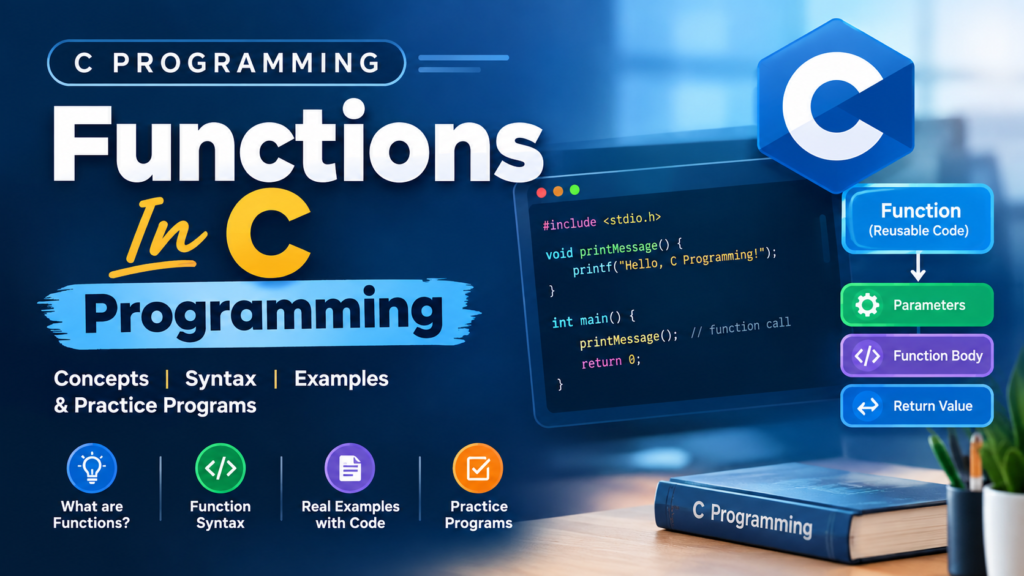
Chapter 13: Functions
📚 C Programming – Complete Course Roadmap
⬅ Previous Chapter | Current Chapter: Functions | Next Chapter ➜
Author: Er. Mujtaba Ansari
Functions make C programs very simple, organized, reusable, readable, and easier to maintain.
Real-Life Uses: Functions are used in operating systems, banking software, games, embedded systems, calculators, automation, and mobile applications to perform specific tasks efficiently.
Functions in C Programming: Complete Guide from Beginners to Advanced
Introduction:
Functions are one of the most important concepts in C programming. They help us divide a large program into smaller, logical, and reusable blocks of code.
Using functions, a program becomes easier to understand, write, test, debug, reuse, and maintain.
In this chapter, you will learn functions in C from basic concepts to advanced topics, including function declaration, definition, calling, parameters, arrays, strings, recursion, nested function calls, and passing values using pointers.
What is a Function in C?
A function is a block or group of statements that are logically related and perform a specific task.
A function can also return a value after performing its operation.
Simple Example
Suppose you want to calculate the sum of two numbers.
Instead of writing the same calculation repeatedly, you can create a function:
int sum(int a, int b)
{
    return a + b;
}
You can then call this function whenever you need to calculate a sum.
Benefits of Functions
Functions make programs:
- Simple and organized
- Easy to understand
- Reusable
- Easier to debug
- Easier to maintain
- Less repetitive
Types of Functions in C
Functions in C are mainly divided into two types:
1. Predefined or Library Functions
These functions are already provided by the C standard library.
Examples:
printf()
scanf()
strlen()
strcpy()
sqrt()
For example:
printf("Hello World");Here, printf() is a library function.
2. User-Defined Functions
A function created and defined by the programmer is called a user-defined function.
Example:
int sum(int a, int b)
{
    return a + b;
}
Here, sum() is a user-defined function.
Three Important Steps of a User-Defined Function
A user-defined function generally involves three main steps:
- Function Declaration or Prototype
- Function Definition
- Function Call
1. Function Declaration / Prototype
A function prototype tells the compiler about the function before it is used.
It specifies:
- Function name
- Return type
- Number of parameters
- Type of parameters
Syntax
return_type function_name(parameter_list);Example
int sum(int x, int y);This tells the compiler that:
- Function name is
sum - It returns an
int - It accepts two
intparameters
2. Function Definition
The function definition contains the actual statements that perform the required task.
Syntax
return_type function_name(parameter_list)
{
    // Function body

    return value;
}
Example
int sum(int x, int y)
{
    int result;

    result = x + y;

    return result;
}
3. Function Call
A function call is used to execute a function.
Example:
result = sum(10, 20);Here, sum() is called with two arguments.
Complete Example of a Function
#include <stdio.h>

int sum(int x, int y);

int main(void)
{
    int result;

    result = sum(10, 20);

    printf("Sum = %d\n", result);

    return 0;
}

int sum(int x, int y)
{
    return x + y;
}
Output
Sum = 30Parameters and Arguments
The values passed to a function are called arguments.
The variables that receive those values inside the function are called parameters.
Example:
sum(10, 20);Here, 10 and 20 are arguments.
In:
int sum(int x, int y)x and y are parameters.
Factorial of a Number Using a Function
The factorial of a positive integer N is:
N! = N × (N-1) × (N-2) × ... × 1For example:
3! = 3 × 2 × 1 = 6Program: C Program to Find Factorial of a Number Using a Function
#include <stdio.h>

unsigned long long factorial(int n);

int main(void)
{
    int n;
    unsigned long long result;

    printf("Enter a number: ");
    scanf("%d", &n);

    if (n < 0)
    {
        printf("Factorial is not defined for negative numbers.\n");
        return 0;
    }

    result = factorial(n);

    printf("Factorial = %llu\n", result);

    return 0;
}

unsigned long long factorial(int n)
{
    unsigned long long fact = 1;
    int i;

    for (i = 1; i <= n; i++)
    {
        fact = fact * i;
    }

    return fact;
}
Example
For:
N = 3Calculation:
1 × 2 × 3 = 6Output:
Factorial = 6Sum of a Series Using a Function
A function can also be used to calculate the sum of a mathematical series.
For example:
1 + X + X² + X³ + ... + XᴺProgram: C Program to Calculate the Sum of a Series Using a Function
#include <stdio.h>

long long seriesSum(int n, int x);

int main(void)
{
    int n, x;
    long long result;

    printf("Enter N: ");
    scanf("%d", &n);

    printf("Enter X: ");
    scanf("%d", &x);

    result = seriesSum(n, x);

    printf("Series Sum = %lld\n", result);

    return 0;
}

long long seriesSum(int n, int x)
{
    long long sum = 0;
    long long term = 1;
    int i;

    for (i = 0; i <= n; i++)
    {
        sum += term;
        term *= x;
    }

    return sum;
}
For:
N = 3
X = 4
The series is:
1 + 4 + 16 + 64 = 85So:
Series Sum = 85Note: If your intended series is
X + X² + ... + Xᴺ, the starting term should be changed accordingly.
Passing Arrays to Functions
Arrays can be passed to functions.
This is useful when we want a function to process multiple values.
For example, we can create a function to find the largest element in an array.
Find the Largest Element in an Array Using a Function
Program: C Program to Find the Largest Element in an Array Using a Function
#include <stdio.h>

int largest(int arr[], int n);

int main(void)
{
    int arr[20];
    int n, i, result;

    printf("Enter number of elements: ");
    scanf("%d", &n);

    if (n <= 0 || n > 20)
    {
        printf("Invalid number of elements.\n");
        return 0;
    }

    printf("Enter %d elements:\n", n);

    for (i = 0; i < n; i++)
    {
        scanf("%d", &arr[i]);
    }

    result = largest(arr, n);

    printf("Largest element = %d\n", result);

    return 0;
}

int largest(int arr[], int n)
{
    int i;
    int max = arr[0];

    for (i = 1; i < n; i++)
    {
        if (arr[i] > max)
        {
            max = arr[i];
        }
    }

    return max;
}
Important Point for YOU:
Array indexing starts from 0.
Therefore, if an array contains n elements, the valid indexes are:
0 to n-1So the loop should use:
i < nnot:
i <= nPassing a 2D Array to a Function
Two-dimensional arrays can also be passed to functions.
For example, consider a 3 × 3 matrix.
We can create a function to print its lower triangular portion.
Write a Program to Print the Lower Triangle of a 3×3 Matrix
#include <stdio.h>

void lower(int arr[][3]);

int main(void)
{
    int arr[3][3];
    int i, j;

    printf("Enter 9 elements of the matrix:\n");

    for (i = 0; i < 3; i++)
    {
        for (j = 0; j < 3; j++)
        {
            scanf("%d", &arr[i][j]);
        }
    }

    printf("\nLower triangular matrix:\n");

    lower(arr);

    return 0;
}

void lower(int arr[][3])
{
    int i, j;

    for (i = 0; i < 3; i++)
    {
        for (j = 0; j < 3; j++)
        {
            if (j <= i)
            {
                printf("%d ", arr[i][j]);
            }
            else
            {
                printf("  ");
            }
        }

        printf("\n");
    }
}
Example
For:
1 2 3
4 5 6
7 8 9
The lower triangular portion is:
1
4 5
7 8 9
Concatenate Two Strings Using a Function
String concatenation means joining two strings together.
For example:
Hello + Worldbecomes:
HelloWorldProgram: C Program to Concatenate Two Strings Using a User-Defined Function
#include <stdio.h>
#include <string.h>

void concat(char x[], const char y[]);

int main(void)
{
    char a[50];
    char b[25];

    printf("Enter first string: ");
    fgets(a, sizeof(a), stdin);

    printf("Enter second string: ");
    fgets(b, sizeof(b), stdin);

    a[strcspn(a, "\n")] = '\0';
    b[strcspn(b, "\n")] = '\0';

    concat(a, b);

    printf("Concatenated string = %s\n", a);

    return 0;
}

void concat(char x[], const char y[])
{
    int i = 0;
    int j = 0;

    while (x[i] != '\0')
    {
        i++;
    }

    while (y[j] != '\0')
    {
        x[i] = y[j];
        i++;
        j++;
    }

    x[i] = '\0';
}
Important Note:
The destination array must have enough space to store both strings.
Copy One String to Another Using a Function
A string can also be copied using a user-defined function.
Program: C Program to Copy One String to Another Using a User-Defined Function
#include <stdio.h>
#include <string.h>

void copyString(char destination[], const char source[]);

int main(void)
{
    char source[50];
    char destination[50];

    printf("Enter a string: ");
    fgets(source, sizeof(source), stdin);

    source[strcspn(source, "\n")] = '\0';

    copyString(destination, source);

    printf("Copied string = %s\n", destination);

    return 0;
}

void copyString(char destination[], const char source[])
{
    int i = 0;

    while (source[i] != '\0')
    {
        destination[i] = source[i];
        i++;
    }

    destination[i] = '\0';
}
Important Difference
Copying:
Source → DestinationConcatenation:
String 1 + String 2 → Combined StringNested Function Calls
When one function calls another function, it is commonly described as a nested function call.
Example:
main()
   ↓
sum()
   ↓
square()
or:
main()
   ↓
sum()
   ↓
cube()
Important Technical Point for YOU:
Standard C does not allow defining one function inside another function.
However, one function can call another function.
Example: Sum of Square and Cube
Program: C Program to Calculate the Sum of Square and Cube Using Functions
#include <stdio.h>

int square(int n);
int cube(int n);
int sum(int n);

int main(void)
{
    int n;
    int result;

    printf("Enter a number: ");
    scanf("%d", &n);

    result = sum(n);

    printf("Sum of square and cube = %d\n", result);

    return 0;
}

int square(int n)
{
    return n * n;
}

int cube(int n)
{
    return n * n * n;
}

int sum(int n)
{
    return square(n) + cube(n);
}For:
N = 3Calculation:
Square = 3² = 9
Cube = 3³ = 27

Sum = 9 + 27 = 36
Recursion in C
Recursion is a programming technique in which a function calls itself.
A recursive function must have a condition that stops further function calls.
A recursive function normally contains two important parts:
1. Base Case
The condition that stops recursion.
2. Recursive Case
The part where the function calls itself.
General Structure
return_type function()
{
    if (base_condition)
    {
        return value;
    }

    return function();
}
Factorial Using Recursion
The factorial formula is:
N! = N × (N-1)!The base case is:
0! = 1Program: C Program to Find Factorial of a Number Using Recursion
#include <stdio.h>

unsigned long long factorial(int n);

int main(void)
{
    int n;

    printf("Enter a number: ");
    scanf("%d", &n);

    if (n < 0)
    {
        printf("Factorial is not defined for negative numbers.\n");
        return 0;
    }

    printf("Factorial = %llu\n", factorial(n));

    return 0;
}

unsigned long long factorial(int n)
{
    if (n == 0 || n == 1)
    {
        return 1;
    }

    return (unsigned long long)n * factorial(n - 1);
}
Working
For:
factorial(3)The calls are:
3 × factorial(2)
        ↓
      2 × factorial(1)
              ↓
                1
Therefore:
3 × 2 × 1 = 6GCD / HCF and LCM Using Recursion
The GCD or HCF is the greatest number that divides two numbers without leaving a remainder.
The Euclidean algorithm uses:
GCD(a, b) = GCD(b, a % b)until the remainder becomes zero.
Program: C Program to Find GCD (HCF) and LCM of Two Numbers Using Recursion
#include <stdio.h>
#include <stdlib.h>

long long gcd(long long a, long long b);

int main(void)
{
    long long x, y;
    long long g, lcm;

    printf("Enter two numbers: ");
    scanf("%lld %lld", &x, &y);

    if (x == 0 && y == 0)
    {
        printf("GCD and LCM are undefined for 0 and 0.\n");
        return 0;
    }

    g = gcd(llabs(x), llabs(y));

    if (x == 0 || y == 0)
    {
        lcm = 0;
    }
    else
    {
        lcm = llabs((x / g) * y);
    }

    printf("GCD/HCF = %lld\n", g);
    printf("LCM = %lld\n", lcm);

    return 0;
}

long long gcd(long long a, long long b)
{
    if (b == 0)
    {
        return a;
    }

    return gcd(b, a % b);
}
Example
For:
X = 12
Y = 18
GCD:
GCD(12,18)
→ GCD(18,12)
→ GCD(12,6)
→ GCD(6,0)
→ 6Therefore:
GCD = 6
LCM = 36
Sum of Squares of First N Natural Numbers Using Recursion
The sum of squares is:
1² + 2² + 3² + ... + N²Program: C Program to Find the Sum of Squares of First N Natural Numbers Using Recursion
#include <stdio.h>

long long sumSquares(int n);

int main(void)
{
    int n;

    printf("Enter N: ");
    scanf("%d", &n);

    if (n < 0)
    {
        printf("Please enter a non-negative number.\n");
        return 0;
    }

    printf("Sum of squares = %lld\n", sumSquares(n));

    return 0;
}

long long sumSquares(int n)
{
    if (n == 0)
    {
        return 0;
    }

    return (long long)n * n + sumSquares(n - 1);
}
For:
N = 3Calculation:
1² + 2² + 3²
= 1 + 4 + 9
= 14
Fibonacci Series Using Recursion
The Fibonacci sequence is commonly defined as:
0 1 1 2 3 5 8 13 ...The formula is:
F(n) = F(n-1) + F(n-2)with:
F(0) = 0
F(1) = 1
Program: C Program to Print Fibonacci Series Using Recursion
#include <stdio.h>

int fibonacci(int n);

int main(void)
{
    int n, i;

    printf("Enter number of terms: ");
    scanf("%d", &n);

    if (n <= 0)
    {
        printf("Please enter a positive number.\n");
        return 0;
    }

    printf("Fibonacci Series: ");

    for (i = 0; i < n; i++)
    {
        printf("%d ", fibonacci(i));
    }

    printf("\n");

    return 0;
}

int fibonacci(int n)
{
    if (n == 0)
    {
        return 0;
    }

    if (n == 1)
    {
        return 1;
    }

    return fibonacci(n - 1) + fibonacci(n - 2);
}
Example
For 7 terms:
0 1 1 2 3 5 8Note: Some textbooks start the Fibonacci series with
1 1 2 3 5.... Both conventions are used, but the program above follows the standard programming definition starting with0, 1.
Passing Values to Functions
Arguments can be passed to functions in different ways.
Two commonly discussed methods are:
- Pass by Value
- Pass by Address using Pointers
Call by Value
In call by value, a copy of the actual value is passed to the function.
Changes made to the parameter inside the function do not change the original variable.
Example:
void change(int x)
{
    x = 100;
}
If we call:
int a = 10;

change(a);
The value of a remains:
10because only a copy of a was passed.
Swap Two Numbers Using Call by Value
Program: C Program to Swap Two Numbers Using a Function and Call by Value
#include <stdio.h>

void swap(int p, int q);

int main(void)
{
    int a = 10;
    int b = 20;

    printf("Before function call:\n");
    printf("A = %d, B = %d\n", a, b);

    swap(a, b);

    printf("\nAfter function call:\n");
    printf("A = %d, B = %d\n", a, b);

    return 0;
}

void swap(int p, int q)
{
    int temp;

    temp = p;
    p = q;
    q = temp;

    printf("\nInside function:\n");
    printf("P = %d, Q = %d\n", p, q);
}
Output Concept:
Inside the function, the values are swapped.
However, the original variables in main() remain unchanged.
This happens because C passes arguments by value.
Call by Address Using Pointers
C does not have true call-by-reference parameters like some other programming languages.
Instead, C passes arguments by value, but we can pass the address of a variable using a pointer.
This allows the function to modify the original variable.
This is commonly called:
- Call by Address
- Passing by Address
- Pointer-based parameter passing
Write a Program to Swap Two Numbers Using Pointers
#include <stdio.h>

void swap(int *p, int *q);

int main(void)
{
    int a = 10;
    int b = 20;

    printf("Before swapping:\n");
    printf("A = %d, B = %d\n", a, b);

    swap(&a, &b);

    printf("\nAfter swapping:\n");
    printf("A = %d, B = %d\n", a, b);

    return 0;
}

void swap(int *p, int *q)
{
    int temp;

    temp = *p;
    *p = *q;
    *q = temp;
}
Output
Before swapping:
A = 10, B = 20

After swapping:
A = 20, B = 10
Here:
&ameans the address of a.
And:
*pmeans the value stored at the address held by p.
Four Common Forms of Functions in C
Functions can commonly be classified according to whether they accept arguments and return a value.
1. No Arguments and No Return Value
void display(void)
{
    printf("Hello");
}
2. Arguments but No Return Value
void display(int n)
{
    printf("%d", n);
}
3. No Arguments but Returns a Value
int getNumber(void)
{
    return 10;
}
4. Arguments and Returns a Value
int sum(int a, int b)
{
    return a + b;
}
The fourth type is very commonly used in real programs.
Local Variables and Global Variables
Local Variable
A variable declared inside a function or block is called a local variable.
Example:
void test(void)
{
    int x = 10;
}
x can normally be accessed only within its scope.
Global Variable
A variable declared outside all functions is called a global variable.
Example:
int count = 0;

int main(void)
{
    printf("%d", count);
    return 0;
}
Global variables can be accessed by multiple functions within their scope.
Best Practice for YOU:
Prefer local variables whenever possible because they make programs easier to understand and maintain.
Recursion vs Iteration
| Recursion | Iteration |
|---|---|
| Function calls itself | Loop repeats statements |
| Uses function-call stack | Usually uses less memory |
| Can make some problems easier to express | Often more efficient |
| Requires a base case | Requires a loop condition |
| Useful for tree and divide-and-conquer problems | Useful for repetitive calculations |
Example of iteration:
for (i = 1; i <= n; i++)
{
    printf("%d ", i);
}
Example of recursion:
void print(int n)
{
    if (n == 0)
        return;

    print(n - 1);
}
Common Mistakes When Using Functions
Mistake 1: Forgetting the Function Prototype
If a function is used before its definition, declare its prototype first.
int sum(int, int);Mistake 2: Incorrect Return Type
If a function returns an integer, its return type should be appropriate.
int sum(int a, int b)
{
    return a + b;
}
Mistake 3: Using <= Instead of < for Arrays
Incorrect:
for (i = 0; i <= n; i++)Correct:
for (i = 0; i < n; i++)Mistake 4: Forgetting the Base Case in Recursion
A recursive function must eventually stop.
Without a proper base case, the program may continue calling the function until the stack is exhausted.
Mistake 5: Confusing Copy and Concatenation
Copying replaces the destination content.
Concatenation joins two strings.
Mistake 6: Using gets()
The old gets() function is unsafe and should not be used.
Use:
fgets()instead.
Old Turbo C Code vs Modern C
Older C programming examples often contain:
#include <conio.h>
clrscr();
getch();
void main()
These are commonly seen in old Turbo C-based textbooks.
For modern C programming, prefer:
#include <stdio.h>

int main(void)
{
    return 0;
}
Also use standard functions such as:
fgets()instead of unsafe input functions such as:
gets()Real-Life Applications of Functions
Functions are used everywhere in software development.
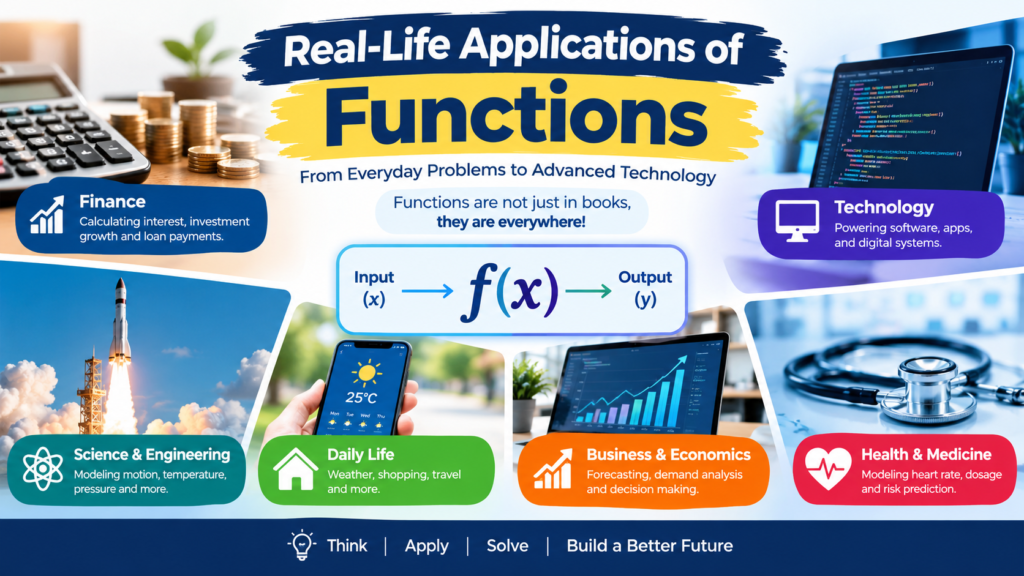
Examples include:
Banking Software
Functions can handle:
deposit()
withdraw()
checkBalance()
transferMoney()
Calculator Applications
Functions can perform:
addition()
subtraction()
multiplication()
division()
Games
Functions can handle:
movePlayer()
calculateScore()
checkCollision()
updateGame()
Operating Systems
Functions perform tasks related to:
memory management
file operations
process management
device handling
Embedded Systems
Functions are used for:
sensor reading
motor control
display control
communication
Advantages of Functions
Functions provide several important advantages:
- Code Reusability
Write once and use multiple times. - Modularity
Large programs can be divided into smaller parts. - Easy Debugging
Individual functions can be tested separately. - Better Readability
Functions make code easier to understand. - Easy Maintenance
Changes can often be made in one function instead of many places. - Reduced Code Duplication
Repeated logic can be placed inside a function.
For Best Programmer – Quick Revision
What is a Function?
A function is a reusable block of code designed to perform a specific task.
Types of Functions
1. Library Functions
2. User-Defined Functions
Three Main Steps
1. Declaration
2. Definition
3. Function Call
Recursion
A function calling itself is called recursion.
Two Important Cases in Recursion
1. Base Case
2. Recursive Case
Passing Arguments
Call by Value
Call by Address using Pointers
Four Common Function Forms
1. No arguments, no return value
2. Arguments, no return value
3. No arguments, return value
4. Arguments, return value
Important Practice Programs
writing the following programs using functions:
- Find the sum of two numbers.
- Find the largest of three numbers.
- Find the smallest element in an array.
- Calculate factorial using a function.
- Calculate factorial using recursion.
- Check whether a number is prime.
- Print prime numbers within a range.
- Find the GCD of two numbers.
- Find the LCM of two numbers.
- Generate the Fibonacci series.
- Find the sum of squares of the first N natural numbers.
- Reverse a string using a function.
- Check whether a string is a palindrome.
- Copy one string to another.
- Concatenate two strings.
- Find the length of a string without using
strlen(). - Find the largest element of an array.
- Sort an array using a function.
- Add two matrices using a function.
- Swap two numbers using pointers.
Frequently Asked Questions (FAQs)
What is a function in C?
A function is a reusable block of statements that performs a specific task.
Why are functions used in C?
Functions make programs modular, reusable, readable, and easier to maintain.
What is a user-defined function?
A function created and defined by the programmer is called a user-defined function.
What is a function prototype?
A function prototype informs the compiler about the function’s name, return type, and parameters.
What is recursion?
Recursion is a technique where a function calls itself.
What is a base case?
A base case is the condition that stops recursive function calls.
Does C support call by reference?
C does not provide true call-by-reference parameters. C uses pass-by-value. However, pointers can be used to pass addresses and modify the original variables.
Can arrays be passed to functions?
Yes. Arrays can be passed to functions, allowing the function to process their elements.
Can strings be passed to functions?
Yes. Since strings are character arrays in C, they can be passed to functions using character-array parameters or pointers.

Mujtaba Ansari is a Software Engineer, Founder & CEO of The Tech Earth. He writes about technology, AI, software, cybersecurity, blogging, Health tech, Agri Tech and digital trends to help readers stay updated with the latest innovations.