
CHAPTER- 02 :
History and Evolution of C Programming Language: Origin, Development and Impact on Modern Programming
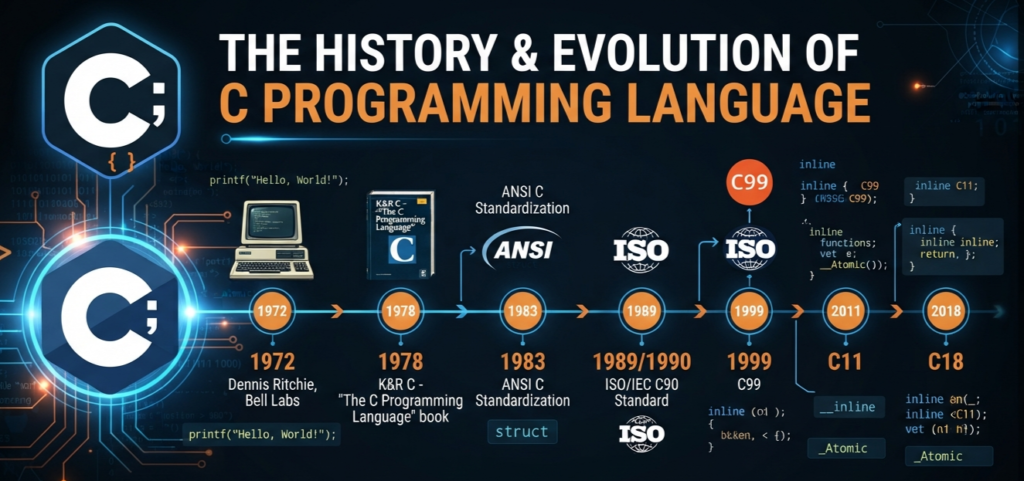
The C programming language was developed by Dennis Ritchie at Bell Labs in the early 1970s. It was created as an improved version of the B programming language to develop the UNIX operating system efficiently. Over time, C evolved through various standards such as C89, C90, C99, C11, C17, and C23, adding new features and improvements. Due to its speed, portability, and efficiency, C became the foundation for many modern programming languages, including C++, Java, and C#. Today, C remains widely used in operating systems, embedded systems, and software development.
 C Programming Complete Course Roadmap
✅ Chapter 1: C Programming Fundamentals
✅ Chapter 2: History and Evolution of C Language (Current Chapter)
 Chapter 3: Installing a C Compiler
Chapter 4: Writing Your First C Program
Chapter 5: Structure of a C Program
Chapter 6: Variables and Data Types
Chapter 7: Operators in C
Chapter 8: Input and Output Functions
Chapter 9: Conditional Statements
Chapter 10: Loops in C
Chapter 11: Arrays
Chapter 12: Strings
Chapter 13: Functions
Chapter 14: Pointers
Chapter 15: Structures and Unions
Chapter 16: File Handling
What is C Language?
C is a general-purpose programming language that is used to create software, operating systems, applications, and embedded systems. It was developed by Dennis Ritchie at Bell Laboratories in 1972. C is known for its simplicity, speed, and efficiency, making it one of the most popular programming languages in the world.
The C language allows programmers to write instructions that a computer can understand and execute. It provides various features such as variables, data types, operators, functions, loops, and conditional statements, which help developers build powerful programs. Because C is a structured programming language, it makes code easier to read, understand, and maintain.
Many modern programming languages, including C++, Java, C#, Objective-C, and PHP, have been influenced by C. Due to its flexibility and performance, C is widely used in operating systems, device drivers, databases, embedded systems, and application development.
Key Features of C Language
- Simple and easy-to-understand syntax
- Fast execution speed
- Portable across different platforms
- Supports structured programming
- Efficient memory management
- Rich set of built-in operators and functions
- Suitable for both system and application programming
Why is C Language Important?
C language is important because it forms the foundation of modern programming and computer science. It is often called the “Mother of Modern Programming Languages” because many popular programming languages are based on its concepts and syntax.
One of the biggest reasons for the popularity of C is its ability to provide direct access to computer memory and hardware. This makes it ideal for developing operating systems, embedded systems, and performance-critical applications. Many operating systems, including parts of UNIX, Linux, and Windows, are written using C.
Learning C helps beginners understand core programming concepts such as variables, loops, functions, pointers, memory management, and data structures. These concepts are useful when learning advanced programming languages later.
Importance of C Language
- Provides a strong foundation for programming.
- Helps understand how computers and software work.
- Widely used in operating systems and embedded systems.
- Improves problem-solving and logical thinking skills.
- Serves as a base for learning C++, Java, Python, and other languages.
- High demand in software development and engineering fields.
- Used in system programming, networking, and hardware-related applications.
Even after more than 50 years since its creation, C remains one of the most widely used and respected programming languages due to its speed, reliability, and versatility.
What is the History of C Language?
The history of the C programming language dates back to the early 1970s when Dennis Ritchie developed it at Bell Laboratories (Bell Labs). C was created as an improved version of the B programming language to support the development of the UNIX operating system. Its goal was to provide a powerful, efficient, and flexible programming language that could handle system-level programming tasks.
Over time, C became one of the most widely used programming languages because of its speed, portability, and ability to interact directly with computer hardware. Today, C is considered one of the most influential programming languages in the history of computer science.
Overview of C Programming History
The evolution of C language began with earlier programming languages such as BCPL (Basic Combined Programming Language) and B Language. These languages inspired the creation of C, but they lacked several features required for advanced software development.
In 1972, Dennis Ritchie introduced C and used it to rewrite the UNIX operating system. This significantly increased the popularity of both UNIX and C. As the language gained widespread adoption, several standards were introduced to improve its consistency and functionality.
Some important milestones in C programming history include:
- 1972: C language developed by Dennis Ritchie.
- 1978: Publication of The C Programming Language by Brian Kernighan and Dennis Ritchie.
- 1989: ANSI standardized C as ANSI C (C89).
- 1990: ISO adopted C as the C90 standard.
- 1999: Introduction of C99 with modern features.
- 2011: Release of C11 with multithreading support.
- 2018: C17 released with bug fixes and improvements.
- 2023: C23 introduced new enhancements and updates.
These developments helped C remain relevant and useful for modern software development.
Importance of Understanding C’s Evolution
Understanding the evolution of C language helps programmers learn how programming languages improve over time to meet changing technological needs. By studying C’s history, beginners can understand why certain features were introduced and how modern programming languages were influenced by C.
Learning about C’s evolution also provides insight into the development of operating systems, software engineering practices, and computer programming as a whole. Since many modern languages such as C++, Java, C#, and Objective-C are based on concepts introduced by C, understanding its history makes it easier to learn other programming languages.
For students and developers, knowledge of C’s evolution builds a strong foundation in programming and helps them appreciate the role C has played in shaping modern computing.
Programming Languages Before C
Before the development of the C programming language, several other programming languages were used for software and system development. These languages played an important role in the evolution of programming and inspired the creation of C. However, they had certain limitations that made it necessary to develop a more powerful and efficient language.
BCPL (Basic Combined Programming Language)
BCPL was developed by Martin Richards in 1966. It was designed for system programming and compiler development. BCPL was simple, portable, and widely used for creating operating systems and software tools. Although it was useful, BCPL lacked advanced data types and features required for modern programming.
B Programming Language
The B language was created by Ken Thompson at Bell Labs around 1969. It was derived from BCPL and was mainly used for developing early versions of the UNIX operating system. B was simpler than BCPL, but it had limitations in handling data types and efficient memory management.
Need for a New Language
As computer systems became more advanced, programmers needed a language that offered better performance, improved data handling, and greater flexibility. To address these limitations, Dennis Ritchie developed the C programming language in 1972 at Bell Labs. C introduced powerful features such as data types, operators, functions, and direct memory access, making it more suitable for system programming and software development.
Importance of Earlier Languages
Although BCPL and B are no longer widely used, they played a crucial role in the development of C. Many concepts from these languages were adopted and improved in C, helping it become one of the most successful and influential programming languages in computer science.
Why Was C Language Created?
The C programming language was created to overcome the limitations of earlier programming languages such as BCPL and B Language. During the early 1970s, programmers needed a language that was more powerful, efficient, and flexible for developing system software and operating systems.
At that time, Dennis Ritchie and his team at Bell Laboratories (Bell Labs) were working on the UNIX Operating System. The existing languages lacked advanced features such as proper data types, efficient memory management, and high performance. To solve these problems, Dennis Ritchie developed the C language in 1972.
C was designed to combine the efficiency of low-level languages with the simplicity of high-level languages. This allowed programmers to write fast and portable programs while still having direct access to computer hardware and memory.
Main Reasons for Creating C Language
- To improve upon the limitations of BCPL and B Language.
- To develop and maintain the UNIX Operating System more efficiently.
- To provide better performance and memory management.
- To create portable programs that could run on different computer systems.
- To make system programming easier and more flexible.
Because of these advantages, C quickly became popular and was widely adopted for software development, operating systems, embedded systems, and application programming. Today, it remains one of the most influential programming languages in the world.
Key Features of C Language
The C programming language is one of the most popular and widely used programming languages because of its powerful features. It provides a perfect balance between simplicity, efficiency, and performance, making it suitable for both beginners and professional developers.
1. Simple and Easy Syntax
C has a simple and easy-to-understand syntax. Its structured approach helps programmers write, read, and maintain code efficiently.
2. High Performance
C programs execute very fast because the language is closely related to computer hardware. This makes it ideal for developing operating systems, embedded systems, and high-performance applications.
3. Portability
C is a portable language, meaning programs written in C can run on different platforms with little or no modification.
4. Structured Programming
C supports structured programming through functions, loops, and conditional statements. This helps organize code into smaller and manageable parts.
5. Rich Set of Operators
C provides a wide variety of operators, including arithmetic, relational, logical, bitwise, and assignment operators, making programming more efficient.
6. Memory Management
C allows direct access to memory using pointers. This feature gives programmers greater control over system resources and memory allocation.
7. Function Support
Functions help divide large programs into smaller reusable modules, improving code readability and maintainability.
8. Extensive Standard Library
C comes with a rich standard library that provides built-in functions for input/output operations, string handling, mathematical calculations, and file management.
9. Dynamic Memory Allocation
C supports dynamic memory allocation using functions such as malloc(), calloc(), realloc(), and free(), allowing efficient use of memory during program execution.
10. Foundation for Other Languages
Many modern programming languages, including C++, Java, C#, and Objective-C, are based on concepts introduced by C.
Applications of C Language
The C programming language is widely used in various fields of computer science and software development. Due to its speed, efficiency, and ability to interact directly with hardware, C remains one of the most important programming languages in the world.
1. Operating Systems Development
C is extensively used for developing operating systems such as UNIX, Linux, and parts of Windows. Its ability to manage system resources efficiently makes it ideal for system-level programming.
2. Embedded Systems
C is commonly used in embedded systems such as microcontrollers, smart devices, IoT devices, home appliances, and automotive systems because it provides direct control over hardware components.
3. Device Drivers
Hardware devices such as printers, keyboards, scanners, and graphics cards require device drivers. Many of these drivers are developed using C because of its low-level programming capabilities.
4. Database Systems
Popular database management systems like MySQL, Oracle, and PostgreSQL use C for performance-critical operations and efficient data processing.
5. Application Software
C is used to develop various desktop and utility applications that require high speed and reliability.
6. Game Development
Many game engines and graphics-intensive applications use C due to its fast execution speed and efficient memory management.
7. Compiler Development
Compilers, interpreters, and programming language tools are often written in C because it provides excellent control over system resources.
8. Networking Applications
C is widely used to develop networking software, communication tools, and server applications that require high performance and low-level network access.
9. Cybersecurity Tools
Many security applications, penetration testing tools, and system monitoring programs are built using C because of its direct access to hardware and memory.
10. Scientific and High-Performance Computing
C is used in scientific simulations, mathematical computations, and high-performance computing applications where speed and efficiency are critical.
Why is C Language Still Important Today?
Even after more than 50 years since its creation, the C programming language remains one of the most widely used and respected programming languages in the world. Its speed, efficiency, portability, and reliability make it an essential tool for software developers, system programmers, and engineers.
1. Foundation of Modern Programming
C is often called the “Mother of Modern Programming Languages” because many popular languages such as C++, Java, C#, and Objective-C are based on its concepts and syntax. Learning C helps programmers understand the fundamentals of programming.
2. Used in Operating Systems
Many operating systems, including Linux, UNIX, and parts of Windows, are written in C. Its ability to interact directly with hardware makes it ideal for system-level programming.
3. Essential for Embedded Systems
C is widely used in embedded systems such as microcontrollers, IoT devices, medical equipment, automotive systems, and consumer electronics because it provides efficient memory and hardware control.
4. High Performance and Speed
C programs execute faster than many high-level programming languages. This makes C suitable for applications where performance and resource optimization are important.
5. Strong Industry Demand
Many industries still require C programmers for operating systems, embedded systems, networking software, cybersecurity tools, and hardware-related development.
6. Helps Build Strong Programming Skills
Learning C improves problem-solving abilities and helps programmers understand important concepts such as memory management, pointers, data structures, and algorithms.
7. Portability Across Platforms
Programs written in C can be compiled and executed on different operating systems with minimal modifications, making it a highly portable language.

Mujtaba Ansari is a Software Engineer, Founder & CEO of The Tech Earth. He writes about technology, AI, software, cybersecurity, blogging, Health tech, Agri Tech and digital trends to help readers stay updated with the latest innovations.