

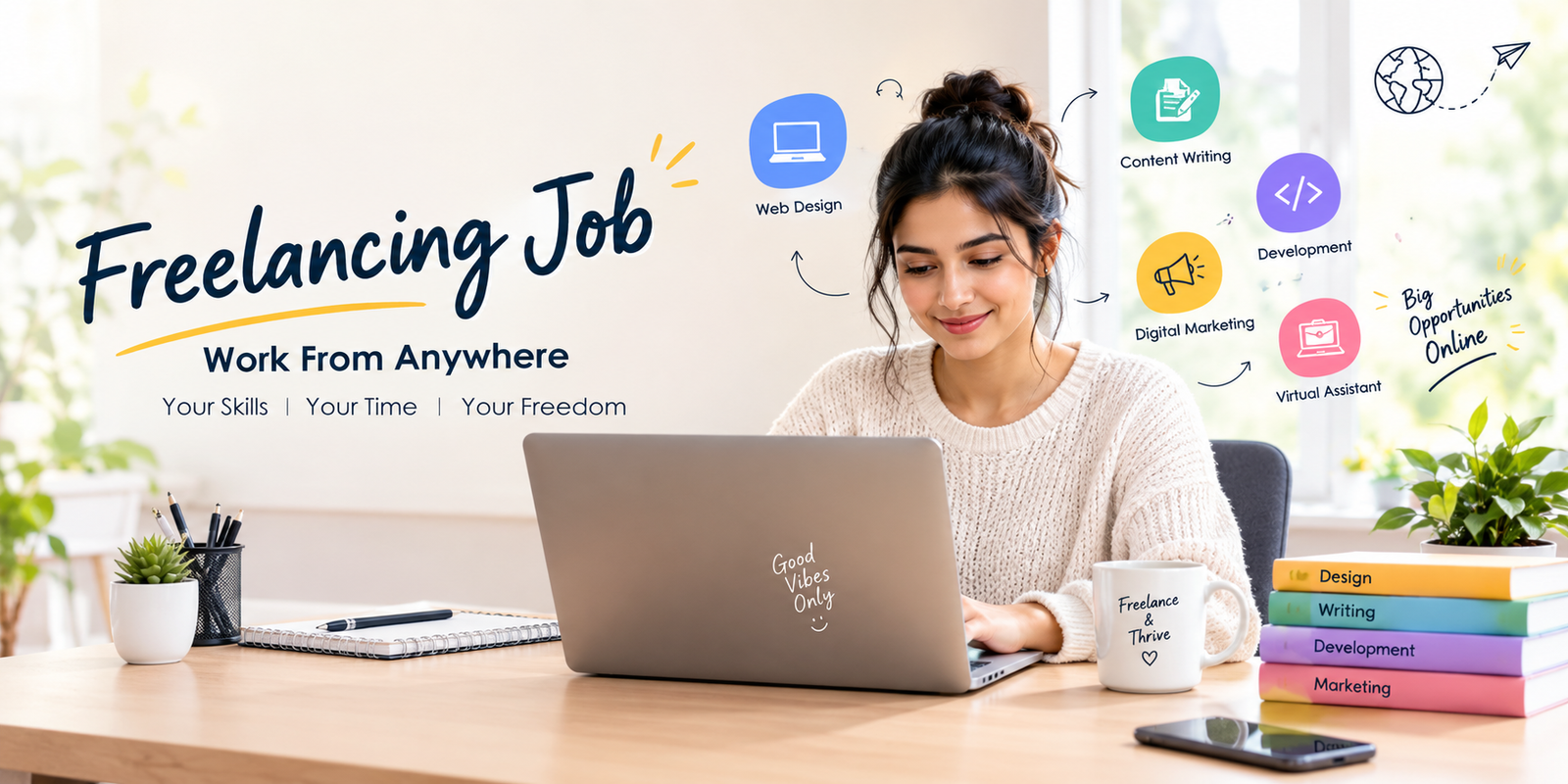
Freelancing Jobs: Complete Guide for Beginners
Freelancing has become a popular way to build a your career, earn money online, and work with clients from different parts of the world. Unlike a traditional full-time job, freelancing gives you the freedom to choose your projects, clients, working hours, and sometimes even your location.
Today, businesses need skilled professionals for everything from content writing and graphic design to e-commerce management, web development, SEO, digital marketing, AI automation, and cybersecurity.
Whether you are a beginner or an experienced professional, freelancing can help you turn your existing skills into a source of income. However, success usually depends on your skills, portfolio, communication, consistency, and ability to deliver quality work on time.
In this guide, we will understand what freelancing is, popular freelance services, its benefits, how to get started, the best freelancing platforms, and the future of freelancing in 2027.
What Is Freelancing?
Freelancing is a form of self-employment where a person provides services to clients on a project, contract, monthly, weekly or hourly basis instead of working as a permanent employee for one company.
A freelancer can work with one or multiple clients at the same time. Depending on the project, they may charge per hour, per project, or according to a fixed contract.
For example, a business may hire a freelance web developer to build a website, a content writer to create blog posts, or an e-commerce specialist to manage online marketplaces.
One of the biggest advantages of freelancing is flexibility or freedom. You can often choose the type of work you want to do and decide which projects match your skills and interests.
Most In-Demand Freelancing Services
The freelance market includes a wide range of digital and professional services. Some of the popular freelance skills include:
- Content Writing & Copywriting
- AI Tools & AI Consulting
- E-commerce Management
- Amazon, Flipkart, Meesho & Shopify Management
- Graphic Design
- Programming or Coding
- E-book Writing and Publishing
- YouTube Management
- Web Development
- Mobile App Development
- Digital Marketing
- SEO Services
- Video Editing
- Social Media Management
- Virtual Assistance
- Data Entry
- AI Prompt Engineering
- UI/UX Design
- WhatsApp API Automation
- AI Automation & Chatbot Development
- Data Analysis & Analytics
- Cybersecurity
- Paid Advertising
The demand for each skill can change over time. Therefore, it is a good idea to learn skills that have practical business value and continue improving them as technology changes.
Benefits of Freelancing
1. Work From Anywhere
One of the biggest advantages of freelancing is location flexibility. Many freelance jobs can be completed remotely using a laptop, internet connection, and the required software or tools.
You may be able to work from home, a coworking space, or while travelling, depending on your profession and client requirements.
2. Flexible Working Hours
Freelancers generally have more control over their schedules than traditional employees.
You can organize your working hours around your projects, deadlines, meetings, and personal responsibilities. However, flexibility does not mean there are no deadlines. Professional freelancers still need to manage their time carefully.
3. Better Earning Potential
Freelancing does not usually come with a fixed salary structure. Your income can depend on your skills, experience, pricing, number of clients, project complexity, and the market you serve.
As you gain experience and build a strong reputation, you may be able to charge higher rates for specialized services.
However, income is not guaranteed, especially when you are starting. Building a stable freelance income usually takes time and consistent effort.
4. Global Client Opportunities
Freelancing platforms and professional networks make it possible to work with clients outside your city or country.
A skilled professional in India, for example, can work with businesses in the US, UK, Canada, Australia, Europe, or other markets.
Working with international clients can also help freelancers gain experience with different business requirements and professional standards.
5. Continuous Learning
Freelancers often work on different projects for different businesses. This exposure can help them learn new tools, technologies, industries, and working methods.
Continuous learning is especially important in technology-related fields because tools and market requirements change quickly.
How to Start Freelancing as a Beginner
Starting freelancing does not require you to master dozens of skills. It is usually better to choose one practical skill, learn it properly, and gradually build experience.
Here is a simple approach:
Step 1: Choose a Skill
Start with a skill that matches your interests and abilities.
For example:
- Writing → Content Writing
- Designing → Graphic Design
- Technology → Web Development
- Marketing → Digital Marketing or SEO
- E-commerce → Marketplace Management
- AI → AI Automation or AI-assisted Services
Step 2: Learn the Basics
Use reliable courses, documentation, tutorials, and practical projects to develop your skills.
Do not focus only on watching tutorials. Try to create real projects because practical experience is important when building a freelance portfolio.
Step 3: Build a Portfolio
A portfolio shows potential clients what you can actually do.
If you do not have paid client work yet, create sample projects. For example, a beginner content writer can create sample blog posts, while a graphic designer can create sample banners, social media designs, or brand concepts.
Step 4: Create a Professional Profile
Create a clear profile that explains:
- What service you provide
- Who you help
- What type of projects you handle
- Your skills and experience
- Examples of your work
- How clients can contact or hire you
Step 5: Start Applying for Projects
Initially, focus on relevant projects rather than applying for every available job.
Read the project requirements carefully and write a short, personalized proposal explaining how you can help.
Step 6: Build Your Reputation
Deliver quality work, communicate clearly, respect deadlines, and ask satisfied clients for reviews when appropriate.
A strong reputation can help you attract better projects over time.
Tips for Freelancing Success
Here are some practical habits that can help you build a long-term freelance career:
- Deliver high-quality work consistently
- Understand the client’s requirements before starting
- Set realistic deadlines
- Communicate professionally
- Keep clients updated about project progress
- Keep learning new tools and skills
- Maintain a strong portfolio
- Avoid taking projects you cannot realistically complete
- Build long-term relationships with good clients
- Develop a professional online presence
- Keep proper records of projects, payments, and expenses
Why Is Freelancing Growing in 2026?
The nature of work is changing rapidly. Remote collaboration, digital businesses, cloud-based tools, artificial intelligence, and online marketplaces have made it easier for companies to work with independent professionals.
Businesses may prefer freelancers when they need specialized expertise for a particular project without hiring a permanent employee.
Some major factors supporting the growth of freelancing include:
- Growth of remote work
- Increasing demand for digital services
- Global access to skilled professionals
- Growth of online businesses
- Increasing use of AI and automation
- Demand for specialized technical skills
- Flexible hiring models
- Expansion of the creator and digital economy
AI is also changing the freelance industry. Instead of simply replacing freelance work, AI tools are becoming part of many freelancers’ workflows. Professionals who know how to use AI effectively alongside their existing skills may be able to work faster and provide more valuable services.
Which Freelancing Platforms Are Best for Beginners?
Several online platforms can help beginners find freelance projects and build their first client relationships.
Popular options include:
- Fiverr – Suitable for offering predefined services or “gigs”
- Upwork – Offers projects across many professional categories
- Freelancer – Includes a wide range of freelance projects
- Truelancer – Popular among freelancers and businesses in different markets
- PeoplePerHour – Focuses on freelance services and project-based work
Each platform has different rules, fees, competition, and types of clients. Before choosing one, compare the platform’s current policies and determine whether your particular skill is in demand there.
Which Freelancing Platforms Can Be Useful for Experienced Professionals?
Experienced freelancers with specialized skills may also explore platforms and professional networks such as:
- Toptal
- Upwork
- Contra
- LinkedIn Services
- Guru
Premium platforms may have stricter requirements or different types of clients. Your experience, portfolio, specialization, and ability to demonstrate results can make a significant difference.
How Much Can a Freelancer Earn?
There is no single fixed income for freelancers.
A beginner may earn relatively little while building skills, finding clients, and developing a portfolio. With experience, specialized skills, repeat clients, and better pricing, income can increase significantly.
Some experienced freelancers earn several lakhs of rupees per month, but this should not be treated as a guaranteed result. Freelance income can vary considerably from month to month.
Your earning potential generally depends on factors such as:
- Skill level
- Experience
- Type of service
- Client location
- Project complexity
- Number of active clients
- Pricing strategy
- Portfolio quality
- Professional reputation
- Ability to retain long-term clients
Instead of focusing only on a specific monthly income target, beginners should first focus on developing a valuable skill and getting their first few successful projects.
Future of Freelancing
The future of freelancing looks closely connected with technology, remote work, AI, automation, and the growth of digital businesses.
Companies will continue to need professionals who can solve specific problems and deliver specialized results.
At the same time, freelancers will need to adapt. Skills that are valuable today may change as new technologies become widely available.
Professionals who combine technical knowledge, creativity, communication, business understanding, and AI tools can be better positioned for the changing freelance market.

Mujtaba Ansari is a Software Engineer, Founder & CEO of The Tech Earth. He writes about technology, AI, software, cybersecurity, blogging, Health tech, Agri Tech and digital trends to help readers stay updated with the latest innovations.