

Chapter 5:
Structure of a C Program
Author: Er. Mujtaba Ansari
Want to learn how a C program works? Understanding the Structure of a C Program is the first step to becoming a C programmer. In this guide, you’ll learn the basic structure, syntax, and essential components of a C program with simple explanations and practical examples.
📚 C Programming Complete Course Structure
✅ Chapter 1: C Programming Fundamentals
✅ Chapter 2: History and Evolution of C Language
✅ Chapter 3: Installing a C Compiler
✅ Chapter 4: Writing Your First C Program
✅ Chapter 5: Structure of a C Program (Current Chapter)
🔜 Chapter 6: Variables and Data Types
🔜 Chapter 7: Operators in C
🔜 Chapter 8: Input and Output Functions
🔜 Chapter 9: Conditional Statements
🔜 Chapter 10: Loops in C
🔜 Chapter 11: Arrays
🔜 Chapter 12: Strings
🔜 Chapter 13: Functions
🔜 Chapter 14: Pointers
🔜 Chapter 15: Structures and Unions
🔜 Chapter 16: File Handling
What is the Structure of a C Program?
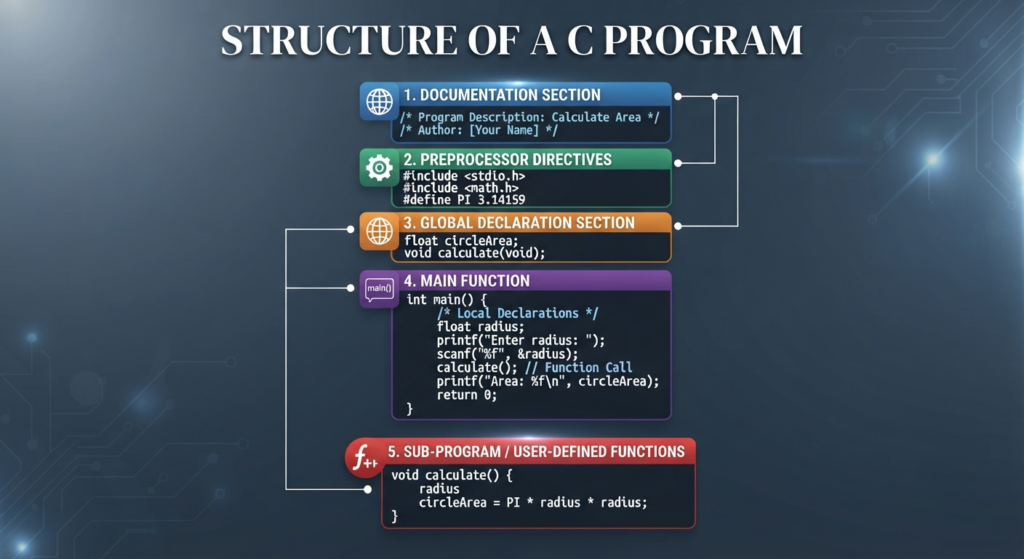
The Structure of a C Program is the standard layout or format that every C program follows. It consists of different sections such as:
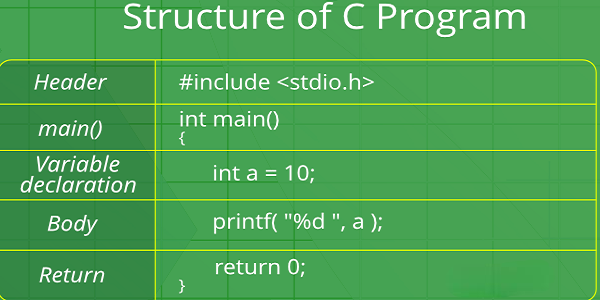
- Header Files
- Main Function
- Variable Declarations
- Program Statements
- Return Statement
Each section has a specific purpose and helps the compiler execute the program correctly.
Basic Syntax of a C Program
#include <stdio.h>

int main()
{
    printf("Hello, World!");

    return 0;
}
This simple program contains all the basic parts of a C program.
Components of a C Program
1. Header File
Example:
#include <stdio.h>What is a Header File?
A header file is a file that provides the compiler with the information needed to use built-in functions in a C program, such as printf() and scanf().
Why is it used?
Without including the required header file, the compiler may not recognize functions like printf() and scanf().
Common Header Files
| Header File | Purpose |
|---|---|
| stdio.h | Input and Output |
| stdlib.h | Memory management and utilities |
| string.h | String functions |
| math.h | Mathematical functions |
| time.h | Date and Time functions |
2. The main() Function
Example:
int main()
{
}
What is main()?
The main() function is the starting point of every C program.
Whenever a C program runs, execution always begins from the main() function.
Think of it as the main entrance of your program.
OR
The main() is a special function in C that serves as the entry point of every program. Whenever a C program is executed, the compiler starts running the code from the main() function.
3. Opening and Closing Braces
{
}
Braces define the beginning and end of a function or block of code.
Everything inside these braces belongs to that function.
4. Variable Declaration
Example:
int age;
float salary;
char grade;
Variables are used to store data.
Before using a variable, it should be declared with its data type.
5. Program Statements
Example:
printf("Welcome to C Programming");Statements are the instructions that tell the computer what to do.
A program may contain one or many statements depending on the task.
6. Return Statement
Example:
return 0;The return 0; statement indicates that the program finished successfully.
It also ends the execution of the main() function.
Complete C Program Example
#include <stdio.h>

int main()
{
    int age = 20;

    printf("Age = %d", age);

    return 0;
}
Output
Age = 20Step-by-Step Explanation
Step 1
#include <stdio.h>Includes the Standard Input Output library.
Step 2
int main()Creates the main function where execution starts.
Step 3
int age = 20;Creates an integer variable named age.
Step 4
printf("Age = %d", age);Prints the value stored in the variable.
Step 5
return 0;Ends the program successfully.
Flow of a C Program
Start

↓

Header Files

↓

main() Function

↓

Variable Declaration

↓

Program Statements

↓

Return Statement

↓

End
Why is the Structure of a C Program Important?
Understanding the structure helps you:
- Write programs correctly
- Avoid syntax errors
- Improve code readability
- Debug programs easily
- Learn advanced C concepts faster
Tips for Writing Better C Programs
- Always include the required header files.
- Keep your code properly indented.
- Use meaningful variable names.
- Add comments when necessary.
- Always end the
main()function withreturn 0;.
Common Mistakes Beginners Make
Missing Header File
Incorrect:
printf("Hello");Correct:
#include <stdio.h>Missing Semicolon
Incorrect:
printf("Hello")Correct:
printf("Hello");Missing Braces
Incorrect:
int main()
printf("Hello");
Correct:
int main()
{
    printf("Hello");
}
Advantages of Following a Proper Program Structure
- Easy to understand
- Easy to maintain
- Better debugging
- Professional coding style
- Faster development
- Cleaner code
Essential Points
- Every C program starts with header files.
- Execution begins from the
main()function. - Variables store data.
- Statements perform tasks.
return 0;ends the program successfully.
Frequently Asked Questions (FAQs)
1. What is the structure of a C program?
The structure of a C program is the standard format that includes header files, the main() function, variable declarations, program statements, and the return statement.
2. Why is the main() function important?
The main() function is the entry point of every C program. Program execution always starts from it.
3. What is the purpose of #include <stdio.h>?
It includes the Standard Input Output library, allowing functions like printf() and scanf() to be used.
4. Why do we use return 0;?
It indicates that the program has completed successfully and exits the main() function.
5. Can a C program run without main()?
No. A standard C program requires the main() function because execution begins from it.
6. What are the main components of a C program?
A C program consists of header files, the main() function, variable declarations, program statements, and the return statement.
7. Why are header files used in C?
Header files provide declarations for built-in functions like printf() and scanf().
8. What is the purpose of the main() function?
The main() function is the starting point of every C program where execution begins.
9. Why do we use return 0; in C?
return 0; indicates that the program executed successfully and ends the main() function.
10. Why is the structure of a C program important?
A proper program structure makes the code easy to read, write, debug, and maintain.

Mujtaba Ansari is a Software Engineer, Founder & CEO of The Tech Earth. He writes about technology, AI, software, cybersecurity, blogging, Health tech, Agri Tech and digital trends to help readers stay updated with the latest innovations.