

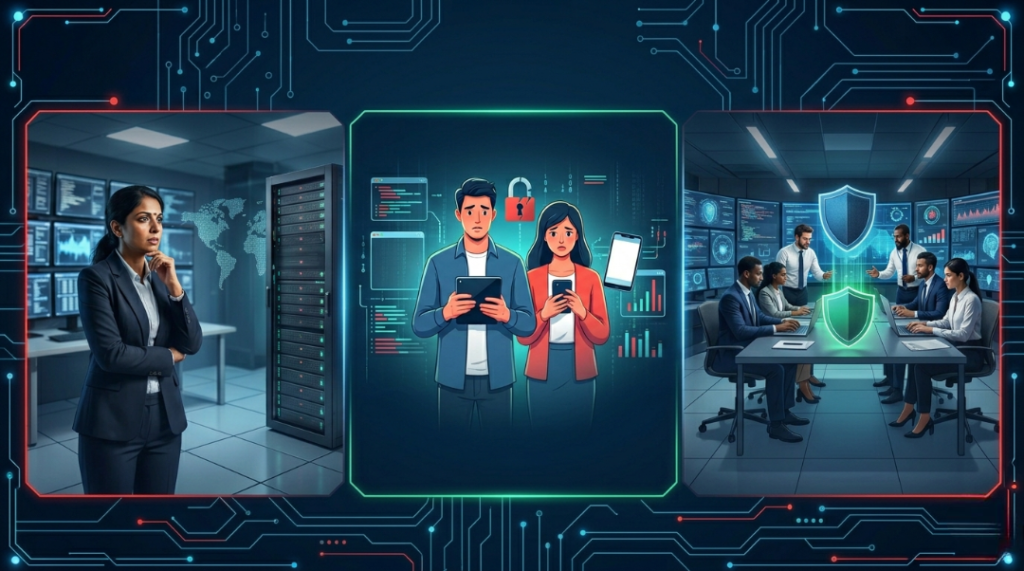
In today’s time, while AI has made our work easier, it has also created new challenges. Yes, we are talking about cyberattacks. These days, cyberattacks are becoming easier to carry out with the help of AI.
Around 80 out of 100 global IT experts believe that AI has now become a major security threat, according to a recent cyberwarfare report released a few days ago.
The report states that cyber warfare is entering a new phase, as AI is now being widely used across companies, the economy, and everyday personal life. The report is based on a survey of 1,900 IT decision-makers working in large organizations.
Technology experts say that AI-powered attacks are extremely fast, and even less experienced hackers can now easily carry out powerful attacks. Because of this, it is becoming increasingly difficult for security teams to detect and prevent them.
As people become more dependent on AI, the risks are also increasing. Today, about 80% of IT experts believe that AI-based attacks have become a serious concern for their organizations.
One important point is that even ordinary individuals can now launch powerful cyberattacks using AI—something that was previously possible only for large organizations or highly skilled hackers. This situation is causing concern among both IT experts and the general public.
Experts also say that as AI continues to grow, cyberattacks are becoming more advanced. While AI is improving security tools on one hand, it is also making it easier for hackers to carry out attacks using advanced technologies.
As a result, companies of all sizes—whether big or small—are now more worried than ever, facing threats not only from highly skilled hackers but also from less experienced attackers.
Here are some simple and effective ways to protect yourself from AI-Hacking Attacks that you should follow —
1️⃣ Always Use a Strong and Unique Password:
Use letters, numbers, and special characters in your password.
Example: Mj@32146#
2️⃣ Turn On Two-Factor Authentication (2FA):
Enable 2FA on your social media, email, and banking apps.
This will keep your account under double security.
3️⃣ Do Not Click on Unknown or Suspicious Links:
Avoid clicking on unknown messages, emails, or WhatsApp links.
AI hackers often send fake links and phishing messages.
4️⃣ Keep Your Software and Apps Updated:
Always update your mobile, laptop, system, tablet, and apps to the latest version.
Updates include security fixes and keep your system secure, which reduces the risk of AI attacks.
5️⃣ Use Antivirus and Security Tools Whenever Possible:
Use a trusted antivirus and firewall.
They help detect malicious files and hacking attempts.
6️⃣ Do Not Share Your Personal Information:
Never share your password, OTP, or bank details with anyone.
No legitimate company asks for OTP over a phone call, so never give your OTP to anyone under any circumstances.
7️⃣ Avoid Using Public Wi-Fi Whenever Possible:
Do not perform banking or important logins on public Wi-Fi.
Try to use your own mobile data or internet connection.
Through public Wi-Fi connections, hackers may access or hack your system.
If necessary, you can use a VPN, but it is still safer to use your own mobile network.
8️⃣ Do Not Use Unknown Chargers in Public Places:
Avoid connecting your mobile phone or laptop to unknown chargers in public places.
Through such chargers, your data can be stolen and your system may be hacked.

Mujtaba Ansari is a Software Engineer, Founder & CEO of The Tech Earth. He writes about technology, AI, software, cybersecurity, blogging, Health tech, Agri Tech and digital trends to help readers stay updated with the latest innovations.