
India’s New AI Models: EKA-1, Dhīr 2B and Dhīr 5B Explained in Detail
India is moving towards building its own Artificial Intelligence technology. Discover how EKA-1, Dhīr 2B and Dhīr 5B are designed, their key features, applications, and what they could mean for India’s AI future.
Artificial Intelligence (AI) is changing the way people work, learn, communicate and use technology. From writing content and generating images to software development, data analysis and research, AI tools are making many complex tasks easier and faster.
Platforms such as ChatGPT and Google Gemini have already become popular among students, professionals, developers and businesses.
But what if India could develop its own AI models based on the country’s languages, industries, security requirements and everyday needs?
India is taking steps in this direction.
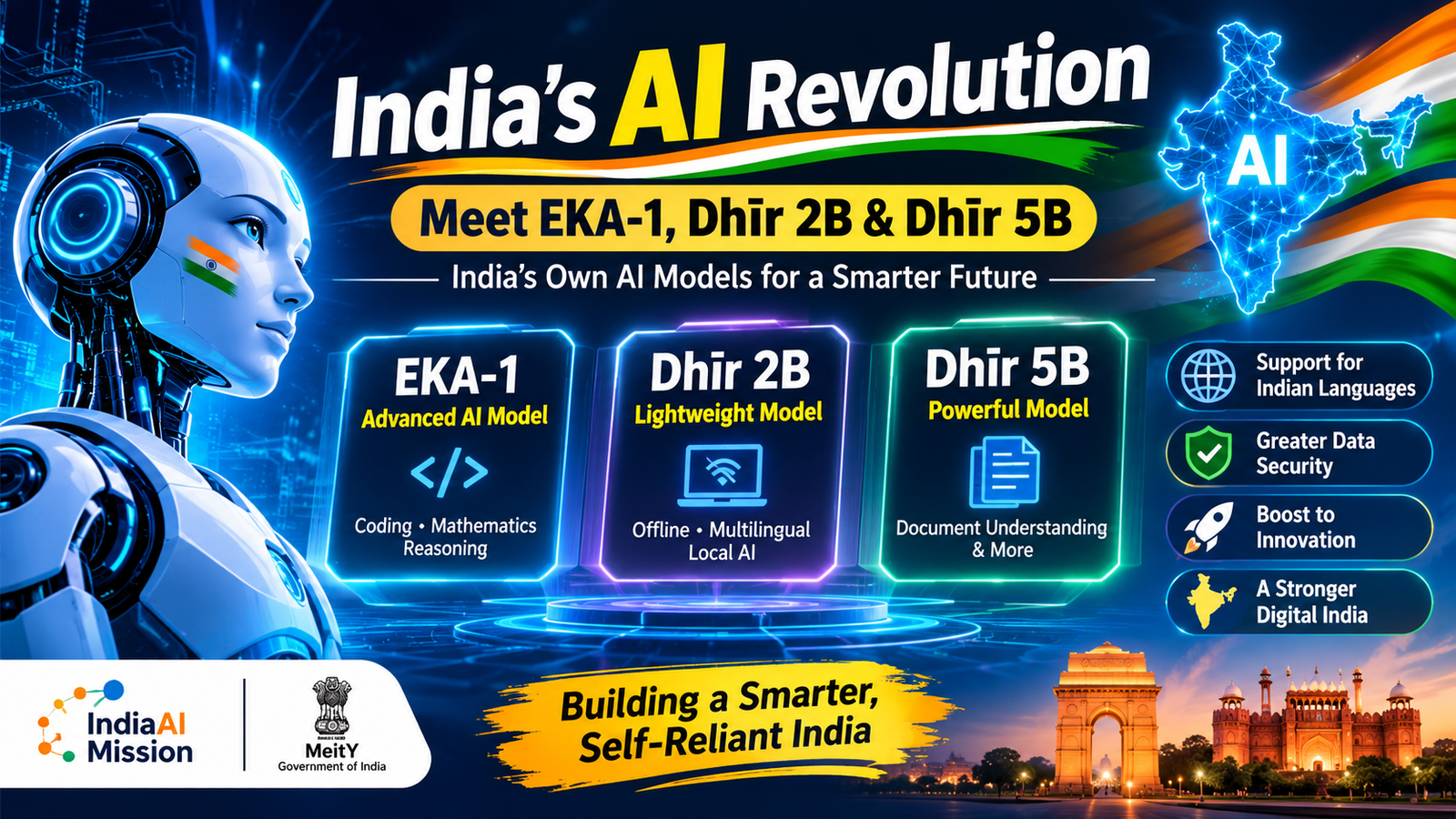
On 3 November 2026, three indigenous AI foundation models were introduced under the IndiaAI Mission: EKA-1, Dhīr 2B and Dhīr 5B.
These models have been developed by Indian technology companies Soket Labs Technology and Research and ZenteiQ AiTech Innovations.
Unlike general-purpose AI services, these models are designed with specific use cases in mind, including coding, mathematical reasoning, multilingual AI assistance, document processing, offline AI applications and secure data handling.
In this guide, we will explore what EKA-1, Dhīr 2B and Dhīr 5B are, how they work, their key features, possible applications and how they could contribute to India’s growing AI ecosystem.
What Are India’s New AI Models?

India’s new indigenous AI models include three major models:
- EKA-1: A large AI foundation model developed by Soket Labs, focusing on mathematics, programming, logical reasoning and Agentic AI.
- Dhīr 2B: A lightweight AI model developed by ZenteiQ, designed for local AI assistance and offline applications.
- Dhīr 5B: A larger model in the Dhīr series, focusing on document understanding, knowledge retrieval and secure enterprise applications.
These models have been developed under the Foundation Models Initiative of the Government of India’s IndiaAI Mission, which operates under the Ministry of Electronics and Information Technology (MeitY).
The broader objective is to strengthen India’s ability to develop its own AI technologies instead of depending entirely on AI platforms developed in other countries.
1. What Is the EKA-1 AI Model?
EKA-1 is an advanced AI foundation model developed by Soket Labs Technology and Research Private Limited.
It has been designed to handle technical and knowledge-based tasks such as mathematics, programming, code generation, logical reasoning and Agentic AI applications.
One of the major highlights of EKA-1 is its large training scale and support for Indian languages.
According to the model specifications, EKA-1 contains 26.3 billion parameters and has been trained on approximately 7.5 trillion tokens. It is designed to support all 22 scheduled Indian languages along with English.
Key Features of EKA-1
1. 26.3 Billion Parameters
EKA-1 contains 26.3 billion parameters.
In simple terms, parameters are internal values that an AI model learns during training. They help the model identify language patterns, understand relationships between information and generate appropriate responses.
2. Support for 22 Indian Languages
India has a rich linguistic diversity, and language accessibility is an important part of digital development.
EKA-1 is designed to support all 22 scheduled Indian languages and English. This could help developers create AI applications that communicate with users in different Indian languages.
3. Mathematics and Programming
EKA-1 has been designed for mathematical problem-solving, programming assistance and code generation.
It could help developers, software engineers and technical teams with tasks such as understanding programming problems, generating code and analysing technical information.
4. Advanced Logical Reasoning
Reasoning is the ability to understand a problem, analyse different possibilities and work towards a suitable solution.
EKA-1 is designed to support complex tasks that require multiple reasoning steps and information analysis.
5. Agentic AI Capabilities
Agentic AI refers to AI systems that can work towards a specific goal by performing multiple steps instead of simply responding to individual instructions.
For example, an AI agent could be designed to analyse information, plan a sequence of tasks and perform actions with the help of connected tools.
EKA-1 is intended to support such Agentic AI use cases.
6. Applications in Banking and Cybersecurity
EKA-1 has also been designed with the requirements of banking, financial services and cybersecurity in mind.
It could be used to develop private AI systems and enterprise applications where organisations need greater control over their data and AI infrastructure.
2. What Is the Dhīr 2B AI Model?
Dhīr 2B is a lightweight indigenous AI model developed by ZenteiQ AiTech Innovations.
Its main purpose is to support AI applications that do not always need to depend on cloud servers or continuous internet connectivity.
Most popular AI tools work through cloud-based infrastructure. When users submit a request, it is generally processed by remote servers before the response is delivered.
However, models such as Dhīr 2B are designed to run locally on compatible hardware.
This means that organisations may be able to use AI features directly on their own devices or local infrastructure, depending on hardware and deployment requirements.
This approach can be particularly useful in areas where internet access is limited or data privacy is an important concern.
Key Features of Dhīr 2B
1. Lightweight Architecture
Dhīr 2B is based on approximately 2 billion parameters.
Its relatively smaller size makes it suitable for exploring AI applications on devices and systems with fewer computing resources compared with larger foundation models.
However, actual hardware requirements depend on factors such as model precision, memory usage and software configuration.
2. Multilingual Support
Dhīr 2B is designed to support English and 10 Indian languages.
This can help developers build applications that offer AI assistance to users who prefer communicating in regional languages.
3. Offline AI Processing
One of its important features is the ability to run on compatible hardware without requiring an internet connection for every request.
This can be useful for local AI assistants, internal business tools and applications operating in low-connectivity environments.
4. Better Data Control and Privacy
When an AI model runs on an organisation’s own infrastructure, sensitive information may not need to be sent to external cloud services for every request.
This can give organisations greater control over their information.
It may be particularly useful for government departments, educational institutions and businesses that handle confidential documents.
However, local deployment alone does not guarantee complete security. Proper access controls and security practices are still necessary.
5. Document-Based Automation
Dhīr 2B can be used in applications involving document information retrieval, knowledge search and general enterprise assistance.
For example, a company could build an internal AI assistant that helps employees find information from its documents and knowledge resources.
3. What Is the Dhīr 5B AI Model?
Dhīr 5B is another indigenous AI model developed by ZenteiQ AiTech Innovations.
It is the larger model in the Dhīr series, with approximately 5 billion parameters.
While Dhīr 2B focuses on lightweight AI applications, Dhīr 5B is designed for tasks that may require more advanced document understanding, information retrieval and enterprise-level AI assistance.
It is also designed to support English and 10 Indian languages.
Key Features of Dhīr 5B
1. Approximately 5 Billion Parameters
Dhīr 5B contains approximately 5 billion parameters, compared with around 2 billion in Dhīr 2B.
A higher parameter count does not automatically mean that a model is better. Its actual performance also depends on training data, model architecture, optimisation and independent testing.
2. Local and Offline Deployment
Dhīr 5B is designed to run on compatible devices and local computing infrastructure.
This can help organisations explore AI solutions without depending on a cloud connection for every operation.
3. Document Understanding
One of its major application areas is document understanding.
AI-powered document systems can help users search for information, retrieve relevant content and interact with large collections of documents.
For example, an organisation could build a system that helps employees find specific information from internal reports, policies and business documents.
4. Government and Enterprise Applications
Dhīr 5B is designed with potential applications across several sectors, including:
- Government departments
- Defence-related applications
- Industrial organisations
- Educational institutions
- Enterprise knowledge management
These applications may benefit from local AI deployment and document-based information processing.
5. Open-Source Availability
According to the announced information, ZenteiQ has released the Dhīr model weights under the Apache 2.0 licence.
Technical documentation and evaluation tools are also made available to support developers and organisations.
This can create opportunities for developers, researchers and businesses to explore the models and build their own AI-based applications.
EKA-1 vs Dhīr 2B vs Dhīr 5B: What Is the Difference?
Although all three models are part of India’s indigenous AI development efforts, they have different technical focuses and intended applications.
Here is a simple comparison:
| Features | EKA-1 | Dhīr 2B | Dhīr 5B |
|---|---|---|---|
| Developer | Soket Labs | ZenteiQ | ZenteiQ |
| Parameters | 26.3 Billion | Approx. 2 Billion | Approx. 5 Billion |
| Training | Approx. 7.5 Trillion Tokens | From Scratch | From Scratch |
| Language Support | 22 Indian languages + English | 10 Indian languages + English | 10 Indian languages + English |
| Main Focus | Coding, Mathematics and Reasoning | Lightweight AI | Document AI and Automation |
| Deployment | Enterprise and Private Infrastructure | Local and Offline | Local and Offline |
| Licence / Availability | AIKosh availability | Apache 2.0 | Apache 2.0 |
Note: This comparison is based on the model specifications and intended applications described in the available announcement information. Actual performance should be evaluated through independent benchmarks and practical testing.
Where Can India’s New AI Models Be Used?
Indigenous AI models can create opportunities across several industries.
Their usefulness will depend on how developers and organisations integrate them into real-world applications.
Here are some important areas where these models could be used.
1. Education and Online Learning
AI can make education more interactive and accessible.
Developers could use multilingual AI models to build:
- AI-powered learning assistants
- Educational chatbots
- Automated question-answering systems
- Language-based learning platforms
- Personalised study tools
For example, a student could ask a science or mathematics question in Hindi and receive an explanation through an AI-powered educational application.
2. Banking and Financial Services
The banking industry handles large amounts of customer information, documents and financial data.
AI applications could help with:
- Customer support
- Document processing
- Information retrieval
- Data analysis
- Internal business workflows
Models such as EKA-1 could be explored for technical and reasoning-related applications in this sector.
3. Government Services
Government departments manage large collections of documents, public information and administrative records.
AI-powered systems could help employees and citizens:
- Find information in government documents
- Understand public service information
- Search official records
- Automate selected administrative tasks
- Access information through Indian languages
This could make digital government services easier to use.
4. Cybersecurity
Cybersecurity is becoming increasingly important as businesses and government organisations move more operations online.
AI can support security teams by helping them:
- Analyse security logs
- Identify unusual activities
- Review suspicious patterns
- Organise threat-related information
- Support security investigations
However, AI should be treated as a supporting technology rather than a complete replacement for cybersecurity professionals and dedicated security systems.
5. Business and Enterprise Automation
Businesses perform many repetitive tasks involving documents, customer information and internal data.
AI-powered enterprise applications could help companies with:
- Customer support automation
- Internal knowledge search
- Document management
- Information processing
- Workflow automation
- Employee assistance tools
These solutions could save time and improve operational efficiency when properly implemented.
6. Defence and Sensitive Applications
Some government and sensitive organisations need greater control over their information and technology infrastructure.
Local and on-premise AI deployment can be useful in such environments because organisations can operate AI systems within their own infrastructure.
However, sensitive applications require strict security testing, access controls and human oversight.
What Is an Offline AI Model and How Does It Work?
An offline AI model is an Artificial Intelligence model that can run directly on a compatible computer, device or local server without needing an internet connection for every request.
To understand the difference, let’s look at two common ways of using AI.
Cloud-Based AI
When you use a cloud-based AI tool, your request is generally sent through the internet to a remote server.
The server processes your request and sends the response back to your device.
Offline or Local AI
In a local AI setup, the required model files and supporting software are installed on your device or local server.
The system then processes requests using its available hardware.
Major Benefits of Offline AI
- Less Internet Dependency: AI applications can continue working without a constant internet connection.
- Greater Data Control: Sensitive information can remain within a local environment.
- Low-Connectivity Support: Useful for locations where internet access is limited.
- Local Deployment: Organisations can configure AI systems according to their infrastructure.
- More Control Over Infrastructure: Businesses can manage how and where their AI applications operate.
However, offline AI also has certain requirements.
Running an AI model requires sufficient RAM, storage and processing power. Larger models may need more powerful hardware, and their speed depends on the device being used.
What Is the IndiaAI Mission and Why Is It Important?
The IndiaAI Mission is an initiative of the Government of India designed to encourage Artificial Intelligence research, development, innovation and adoption across the country.
It was approved by the Union Cabinet on 7 March 2024.
The mission focuses on building India’s AI infrastructure, supporting startups, developing indigenous AI technologies and promoting responsible AI adoption.
Seven Key Pillars of the IndiaAI Mission
1. IndiaAI Compute Capacity
This pillar focuses on providing computing resources required for AI research, development and innovation.
2. IndiaAI Innovation Centre
It supports the development of indigenous AI technologies, including foundation models designed for Indian requirements.
3. IndiaAI Datasets Platform (AIKosh)
AIKosh provides datasets and other resources that can support AI research and application development.
4. IndiaAI Application Development Initiative
This initiative encourages the development of AI applications that address real-world challenges and national requirements.
5. IndiaAI FutureSkills
It focuses on developing AI-related skills among students, professionals and researchers.
6. IndiaAI Startup Financing
It aims to support startups working on Artificial Intelligence technologies and innovative AI solutions.
7. Safe and Trusted AI
It promotes responsible, secure and trustworthy AI development and adoption.
EKA-1, Dhīr 2B and Dhīr 5B are associated with the Foundation Models Initiative under the broader IndiaAI Mission.
How Can Indian AI Models Benefit India?
Developing indigenous AI models can create long-term opportunities for India’s technology ecosystem.
Here are some important potential benefits.
1. Reduced Dependence on Foreign AI Technology
Developing domestic AI models can help India build its own technological capabilities.
This may reduce dependence on external platforms for certain applications, particularly in areas where local infrastructure and data control are important.
2. Better Access to Indian Languages
India has many languages and different regional communication needs.
AI models that support Indian languages could make digital services more accessible to people who are not comfortable using English.
3. New Opportunities for Startups
Indian startups and developers could use these models to explore new products and services, including:
- AI chatbots
- Business automation software
- Educational platforms
- Document management tools
- Regional language assistants
- Enterprise AI applications
This could encourage innovation and create new business opportunities.
4. Improved Data Control
Local AI deployment can give organisations more control over how their information is processed and stored.
This is particularly important for businesses and institutions that work with sensitive information.
5. Growth in AI Research and Innovation
Indigenous AI development can encourage researchers, engineers and students to work on new AI technologies.
It can also create opportunities for collaboration between startups, educational institutions and technology companies.
6. New Skills and Career Opportunities
As the AI industry grows, demand for specialised technical skills may also increase.
Some important career areas include:
- Artificial Intelligence Engineering
- Machine Learning
- Data Science
- Natural Language Processing
- Cloud Computing
- Cybersecurity
- AI Application Development
Students and professionals interested in technology can start learning these skills to prepare for future opportunities.
How to Access EKA-1 and Dhīr AI Models?
Students, developers, researchers and organisations interested in these models can start by exploring the AIKosh platform.
AIKosh is associated with the IndiaAI Mission and provides access to AI-related models, datasets and development resources.
Steps to Explore the Models
- Visit the official AIKosh website.
- Open the available Models section.
- Search for EKA-1, Dhīr 2B or Dhīr 5B.
- Open the relevant model information.
- Read the available technical documentation and usage instructions.
- Check the licence and hardware requirements.
- Follow the available installation and deployment instructions before starting development.
Official Platform: https://aikosh.indiaai.gov.in/
Important: Model availability, download access, hardware requirements and deployment instructions may change. Always check the latest official documentation before using or deploying a model.
Can India’s AI Models Compete with ChatGPT and Google Gemini?
This is one of the most interesting questions for people following India’s AI development.
Tools such as ChatGPT and Google Gemini are broad AI platforms designed to support many different tasks, including writing, research, coding, information analysis and everyday assistance.
EKA-1 and the Dhīr models have different development priorities.
For example:
- EKA-1: Focuses on mathematics, coding, logical reasoning and Agentic AI applications.
- Dhīr 2B: Focuses on lightweight, local and offline AI applications.
- Dhīr 5B: Focuses on document understanding, knowledge retrieval and enterprise applications.
- ChatGPT and Gemini: Offer broader AI-powered services across multiple everyday and professional use cases.
It would be too early to declare that India’s new models are better than ChatGPT or Gemini.
A fair comparison would require independent testing of several factors, including:
- Response accuracy
- Coding performance
- Mathematical reasoning
- Indian language understanding
- Processing speed
- Data privacy
- Hardware requirements
- Real-world reliability
The bigger achievement is that India is developing AI technologies based on its own requirements rather than relying entirely on solutions developed elsewhere.
What Is the Future of Artificial Intelligence in India?
Artificial Intelligence is expected to play an increasingly important role in India’s digital economy.
Its applications are not limited to software companies. Several industries could benefit from AI-powered solutions.
Some important sectors include:
- Education: Personalised learning and multilingual educational assistants.
- Healthcare: Administrative automation and information management.
- Agriculture: AI-powered information and decision-support applications.
- Banking: Document processing and customer service automation.
- Manufacturing: Production analysis and operational automation.
- E-commerce: Customer support, product information and business automation.
- Government: Digital services and information retrieval.
For a diverse country like India, AI systems that understand regional languages, local requirements and different internet environments could become especially useful.
Models such as EKA-1, Dhīr 2B and Dhīr 5B represent progress towards building such capabilities.
However, their long-term success will depend on accuracy, reliability, security, hardware costs, developer adoption and their performance in real-world applications.
Frequently Asked Questions (FAQs)
1. What are the new AI models launched in India?
The three indigenous AI models discussed under India’s Foundation Models Initiative are EKA-1, Dhīr 2B and Dhīr 5B. They have been developed by Soket Labs and ZenteiQ AiTech Innovations.
2. Who developed the EKA-1 AI model?
EKA-1 was developed by Soket Labs Technology and Research Private Limited. It focuses on mathematics, programming, reasoning and Agentic AI applications.
3. Who developed Dhīr 2B and Dhīr 5B?
Both Dhīr 2B and Dhīr 5B were developed by ZenteiQ AiTech Innovations.
4. How many parameters does EKA-1 have?
EKA-1 contains approximately 26.3 billion parameters and was trained on around 7.5 trillion tokens.
5. What is the difference between Dhīr 2B and Dhīr 5B?
Dhīr 2B is a lightweight model with approximately 2 billion parameters, while Dhīr 5B contains approximately 5 billion parameters. Both are designed for local AI applications, but Dhīr 5B focuses more on document understanding and enterprise-level assistance.
6. Can Dhīr AI models work without the internet?
They are designed to support local and offline deployment on compatible hardware. However, actual performance depends on the device, software setup and model requirements.
7. How many Indian languages does EKA-1 support?
EKA-1 is designed to support all 22 scheduled Indian languages along with English.
8. How many Indian languages do Dhīr models support?
Dhīr 2B and Dhīr 5B are designed to support 10 Indian languages along with English.
9. Are Dhīr AI models open source?
According to the announced specifications, ZenteiQ has released the Dhīr model weights under the Apache 2.0 licence, along with technical documentation and evaluation tools.
10. Where can I explore India’s new AI models?
You can visit the official AIKosh platform at https://aikosh.indiaai.gov.in/ to explore available AI models, datasets and related resources.
Conclusion: Is India Moving Towards Its Own AI Future?
India’s new AI foundation models, EKA-1, Dhīr 2B and Dhīr 5B, represent an important step in the country’s Artificial Intelligence development journey.
Each model has a different purpose.
EKA-1 focuses on advanced reasoning, mathematics, programming and Agentic AI. Meanwhile, Dhīr 2B and Dhīr 5B focus on lightweight, multilingual and locally deployable AI applications.
These technologies could create new opportunities for Indian developers, startups, researchers, educational institutions and businesses.
They could also encourage the development of AI applications that better understand India’s languages, industries and digital requirements.
Of course, the real success of these models will depend on their practical performance, reliability, security and adoption.
India’s AI future is not just about using Artificial Intelligence developed by others. It is also about building its own technology, developing new ideas and creating solutions for the country’s needs.
The next phase of India’s technology growth could be shaped by how effectively it develops, improves and uses its own AI innovations.



Mujtaba Ansari is a Software Engineer, Founder & CEO of The Tech Earth. He writes about technology, AI, software, cybersecurity, blogging, Health tech, Agri Tech and digital trends to help readers stay updated with the latest innovations.
Was this article helpful?
Your feedback helps us improve The Tech Earth.
Helpful: 0 Not helpful: 0