Development of Computer

development of computers

CHAPTER : 02

(2.1) History of Computer -

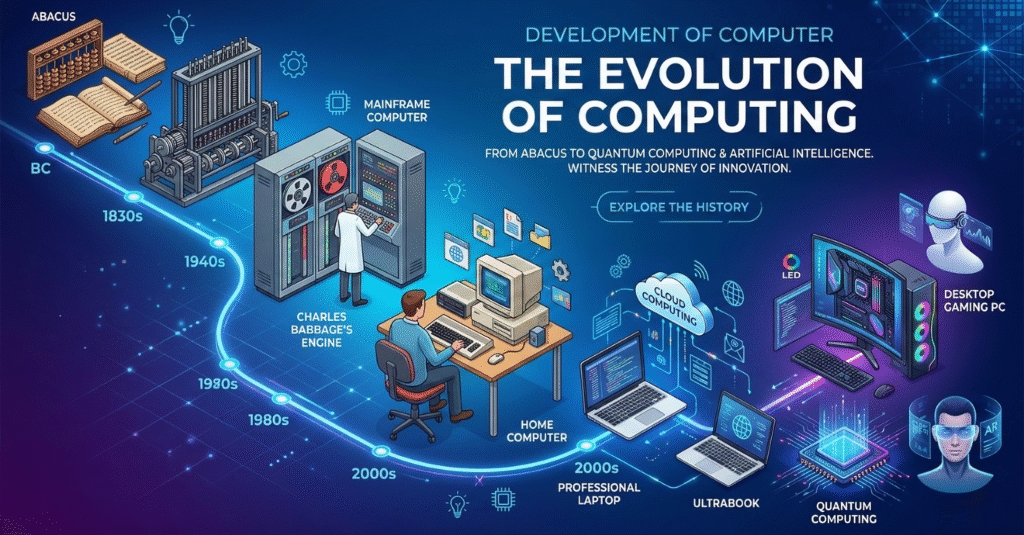
➠ In the 19th century, British mathematics professor Charles Babbage introduced the term computer. It evolved from a wooden abacus to the latest high-speed microprocessor. Charles Babbage created the Analytical Engine, the basis on which today's computers operate.
The world of computer technology continues to evolve from time to time. Therefore, the following is a list of who created and introduced which type of computer to the world from the beginning -

(1) Abacus -

It is considered the world's first calculating device. It was invented in China in the 16th century. It was used for arithmetic calculations. It made calculations easier with the help of circular beads strung on wires.

  (2 ) Pascaline -

The Pascaline, also known as Pascal's calculator, was invented in 1642 by the French mathematician Blaise Pascal, who invented the first mechanical calculating machine. It consisted of a parallelogram box with eight movable wheels. It could only add or subtract. Therefore, it was also called an adding machine.
 (3) Difference Engine or Mechanical Computer and Analytical Engine -
Charles Babbage, known as the father of the computer, invented the Difference Engine in 1822, which was powered by steam and could perform calculations. This Difference Engine is also known as a mechanical computer.

In 1833, Charles Babbage created an automatic machine, the Analytical Engine, which could perform arithmetic calculations such as addition, subtraction, multiplication, and division according to punch card instructions.

 (4) Punch Card -

Punch cards were invented by American scientist Herman Hollerith in 1880, which were similar to today's computer cards.

  (5) Vaccum Tube -

It was used in 1st Generation computers. Used vacuum tubes for circuitry and magnetic drums for memory, resulting in massive, hot, and energy-inefficient machines, dominating from the early 1940s to the mid-1950s.

These, for example ENIAC (Electronic Numerical Integrator and Computer)UNIVAC (Universal Automatic Computer), and IBM 701.

(6) ENIAC - Electronic Numerical Integrator and Computer / Calculator -

American scientists John Mauchly and J. P. Eckert invented the first general-purpose electronic computer, called the ENIAC, in 1946. It was used for weather forecasting and scientific purposes.

(7)  UNIVAC  1 - Univarsal Automatic Computer -

It was developed by GEC (General Electric Corporation) in 1954. It was the first computer used for business and other general purposes.

(8) Transister -

It was used in 2nd generation computers which work faster than 1st generation computers. Ex.: IBM 1401, UNIVAC - 1107

  (9)  I.C. - Integrated Circuit -

It was used in the 3rd Generation and its latest form was introduced by Intel which was called Micro-processor. IC - commonly known as a chip or microchip, is a tiny electronic device that packs thousands to billions of transistors, resistors, and capacitors onto a single small piece of semiconductor material, usually silicon.

   (10)  Micro-Processor  - 

Developed by Intel in 1970, it revolutionized the computer industry. The first microprocessor, the Intel 4004, was developed in 1970. Its development made possible the creation of smaller computers, known as microcomputers.

A microprocessor is a very small processing unit inside a CPU. It performs essential arithmetic, logical, and control operations, acting as the "brain" of systems ranging from smartphones to computers.

(2.2) Computer  Generation -

Computers have been developing from its inception till today, during this time the computer has come out of "Vaccum Tube" and reached "Artificial Intelligence" and it has left a big room and is sitting in the hands. It has achieved this progress in the last 70-80 years.

This development period of computers is called Computer Generation. As changes took place in computer hardware and software, computer generations were determined accordingly. Till now 5 generations of computers (5th Generation of Computers) have been determined. Now research is going on for the next generations.
(1.) First Generation : 
Computers developed between 1942 and 1955 are known as the First Generation. First-generation computers were developed using vacuum tube technology.

Memory Used - Punch cards, paper tape

Speed - Milliseconds (ms)

Some examples of first-generation computers are: Mark-1, IBM-650, IBM-701, UNIVAC, EDSAC, ENIAC, EDVAC, etc.

Uses - Scientific and defense applications.
(2.) Second Generation :
Computers developed between 1955 and 1964 are known as the Second Generation. Second-generation computers were developed using transistor technology instead of vacuum tubes.

Memory Used - Magnetic Disk, Magnetic Tape, Magnetic Memory.

Speed - Microsecond (ms)

Some examples of computers from this generation include: IBM1620, IBM7094, Honeywell 400, UNIVAC-1108, CDC 1604, and CDC 3600.

Uses - In commercial and scientific use.
(3.) Third Generation :
Computers developed between 1964 and 1975 are known as the Third Generation. This generation used ICs. The full form of IC is Integrated Circuit. IC was developed by Jack Kilby in 1958.

Memory Used - Increase in Storage Capacity in Magnetic Memory

Speed - Nano second (ns)

Some examples of computers of this generation are: IBM-360 Series, Honeywell-600 Series, PDP (Personal Data Processor)

Uses - Personal use of computers.
(4.) Fourth Generation :
This generation is considered to have begun from 1975 to 1989. Modern IC technology was used in this generation. This IC technology was VLSI (Very Large Scale Integration). High-level programming languages were used for programming.

Memory Used - Semiconductor Memory

Speed - Pico-second (ps)

Some examples of fourth-generation computers are: Star 1000, Dec 10, PDP 11, CRAY-1, CRAY-X-MP (Super Computer), PCs.

Uses - Increase in personal use, commercial production.
(5.) Fifth Generation :
This generation is considered to have begun in 1989. This generation introduced modern IC technology, known as ULSI (Ultra Large Scale Integration). High-level programming languages were used, making them simpler. These languages also used GUIs (Graphical User Interfaces).

Memory Used - Optical Disks, Virtual Memory

Speed - Extremely high speed.

Some examples of fifth-generation computers are: Desktops, Laptops, Notebooks, Ultrabooks, Chromebooks, etc.

Uses - Internet and multimedia use.

(2.2.1) Next Generation Of Computer -

The next generation of computers, often referred to as the 6th generation, is focused on breaking current performance limits through quantum computing, nanotechnology, and advanced AI. Machines in this generation aim to process data at exponential speeds, such as by using qubits. These future technologies are likely to have advanced features such as self-learning capabilities, brain-computer interfaces, and high-efficiency photonic systems. And as that time has passed, they are now being implemented.
(1) Nano Computer :
- Using nanotubes fabricated at the nanoscale (10^-9m), efforts are underway to develop extremely small and large-capacity computers.


It is a computer built using nanotechnology, where components such as transistors and circuits are on the nanoscale—that is, extremely small, around the size of an atom or molecule. They are extremely small in size, allow fast processing, and consume very little power. In the future, they will be used—and are already being used—in smart sensors, medical devices, and advanced electronics devices and machines.
(2) Quantum Computer :
- This computer is based on the quantum theory of light, where data is stored and processed using quantum particles. These particles exist in pairs and are called "q-bits."
Technology and characteristics of the next generation of computers :
AI & Neuromorphic Computing

Nano technology

Quantum Computing

Brain Computer Interface (BCI)

Photonic Computing
(2.3) Types of Computer -
There are three types of computers based on their working method:
(1) Analog Computer
(2) Digital Computer
(3) Hybrid Computer