
Table of Contents
ToggleCHAPTER : 01
(1.1) What is Computer ?
A computer is an automatic electronic machine that accepts data, stores it, processes it according to the given instructions and provides the processed results as output as required.
(1.2) Father of Computer -
Charles Babbage is considered the father of the computer. He was born in London. He was a mathematics professor who invented the computer in the 19th century. Initially, these computers were very large in size and were powered by steam. This machine could store programs and was also suitable for performing calculations and printing the results. Charles Babbage named this machine the Analytical Engine.
(1.3) Full Form Of Computer -
• C - Commonly
• O - Operate
• M - Machine
• P - Particularly
• U - Used
• T - Technical
• E - Educational
• R - Research
• O - Operate
• M - Machine
• P - Particularly
• U - Used
• T - Technical
• E - Educational
(1.4) Classification of Computer -
Computers are primarily divided into two parts, as follows:
1. Hardware
2. Software
1. Hardware : -
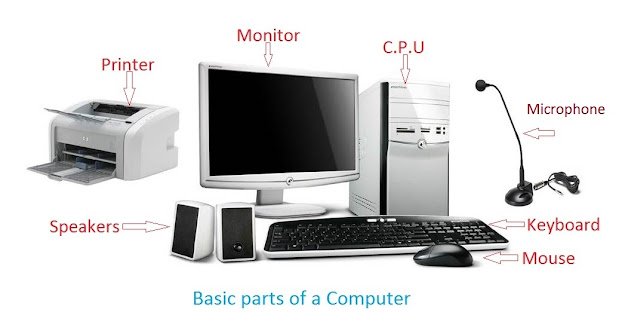
All the physical parts of a computer that we can see and feel by touching are called hardware.
For example, monitor, keyboard, printer, mouse, speaker, etc.
2. Software : -
All the parts of a computer that we cannot physically see or touch are called software.
The set of instructions and programs that tell the computer what to do and how to do it is called software.
* Software is further divided into two parts, which are as follows:-
:: Software ::
1. System Software
2. Application Software
1. System Software : -
- The part of software that is designed to run the computer, control it, maintain its various parts, and utilize all its capabilities efficiently is called system software.
For example: Operating System, Language Translator, Utility Software, etc.
2. Application Software : -
- This software refers to all those programs that you use in your daily work and which we all use specifically for different tasks. Such as: Medical Software, Entertainment Software, Corel Draw, Accounting Software etc.
(1.5) Functions Of Computer -
A computer is an automated electronic machine that functions in three ways:
It accepts input data, stores it,
Processes it according to the instructions provided,
Distributes the analyzed results as information or output results, as required.
(1.6) Computer parts Name -
- Micro Processor.
- Mother Board.
- Memory.
- Hard Disk Drive.
- Modem.
- Sound Card.
- Monitor.
- Keyboard/Mouse.
(1.7) Characteristics Of Computer -
Some of the key features of a computer are:
Speed
Storage Capacity
Security
Automation
Paper Less
High Memory Capacity
Never Tired
Accuracy
Trustworthy
Future Technology Indicate
(1.8) Applications Of Computer -
In this modern age, computers are being used almost everywhere. Therefore, the following are the uses of computers in some specific areas:
In Communications Technology
Education
Banks
Entertainments
Weather Forecasting
Medicals
Reservations
Space Technology
In Robotics
Trace Any Location
All Companies or Industries and Offices
In Future Knowledge
Airports
Online Business
:: Objective Questions ::
(1) When is Computer Literacy Day celebrated?
(a) January 1 (b) January 22
(c) December 1 (d) December 2
(e) December 16
(2) What is multi-processing?
(a) Without a processor (b) By a single processor
(c) By more than one processor (d) By two disks
(e) None of these
(3) Input is converted to output by:
(a) Memory (b) CPU
(c) Peripherals (d) By input and output
(e) All of the above
(4) Which is the first computer literate district in the country?
(a) Malappuram (Kerala) (b) Billupuram
(c) Thiruvalpur (d) Anokulam
(e) Bengaluru
(5) _______ represents raw facts, while _______ makes data meaningful. (IAS)
(a) Information, bits
(b) Information, reporting
(c) Records, bytes
(d) Bits, bytes
(e) Data, information
(6) What was the famous computer called Pacman designed for?
(a) Banks
(b) Stock exchanges
(c) Sports
(d) Book publishing
(e) None of these
(7) What is the name of the first computer manufactured in India?
(a) Aryabhatta
(b) Siddhartha
(c) Ashoka
(d) Buddha
(e) Burjesh
(8) What is the number of 'Function Keys' on a keyboard?
(a) 16 (b) 12
(c) 36 (d) 17
(e) 11
(9) What is the technology or facility for connecting hardware and software called?
(a) Internet
(b) EPROM
(c) Intercom (d) CD RAM
(e) Interface
(10) According to one estimate, the year by which 70% of the world's population will be confined to cities is?
(a) 2022 (b) 2035
(c) 2050 (d) 2060
(e) 2045
(11) What is meant by data processing?
(a) Organizing data (b) Data storage
(c) Making data useless (d) Making data useful
(e) All of the above
(12) A computer processes information into information by:
(a) Input
(b) Numbers
(c) Data
(d) Processor
(e) All of the above
(13) Which of the following is not a characteristic of a computer?
(a) Confidentiality
(b) Intelligence
(c) Quick decision-making ability (d) Variety
(e) None of the above
(14) What is data in a computer?
(a) Symbols
(b) Numbers
(c) Symbolic and numerical information
(d) Given information
(e) None of the above
(15) Where was India's first computer installed?
(a) Indian Statistical Institute, Kolkata (b) Indian Institute of Science, Bengaluru
(c) Indian Iron and Steel Company, Burnpur (d) Indian Institute of Technology, Delhi
(e) NIT Jamshedpur
(16) Which shortcut key is used to close a document?
(a) Ctrl + Q (b) Ctrl + W
(c) Ctrl + C (d) Alt + F4
(e) Alt + F3
(17) What is the Hindi name for a computer?
(a) Calculator (b) Shift-Gunak
(c) Computer (d) Calculator
(e) None of these
(18) What are Ctrl, Shift, and Alt keys called?
(a) Joystick (b) Function
(c) Modifier (d) Alpha-Numeric
(e) All of the above
(19) What is the pattern of printed lines on most products called?
(a) Prices (b) Scanners
(c) Code (d) Barcode
(e) MRP
(20) What is a collection of information?
(a) Print-out (b) File
(c) Path (d) Printer
(e) Mouse
ANSWERS
| (1)- d | (2)- c | (3)- b | (4)-a |
| (5)- e | (6)- c | (7)- b | (8)- b |
| (9)- e | (10)-c | (11)-d | (12)-c |
| (13)-b | (14)-c | (15)-a | (16)-b |
| (17)-c | (18)-c | (19)-d | (20)-b |